

How acupoints being sensitized and play for diseases diagnosis and treatment
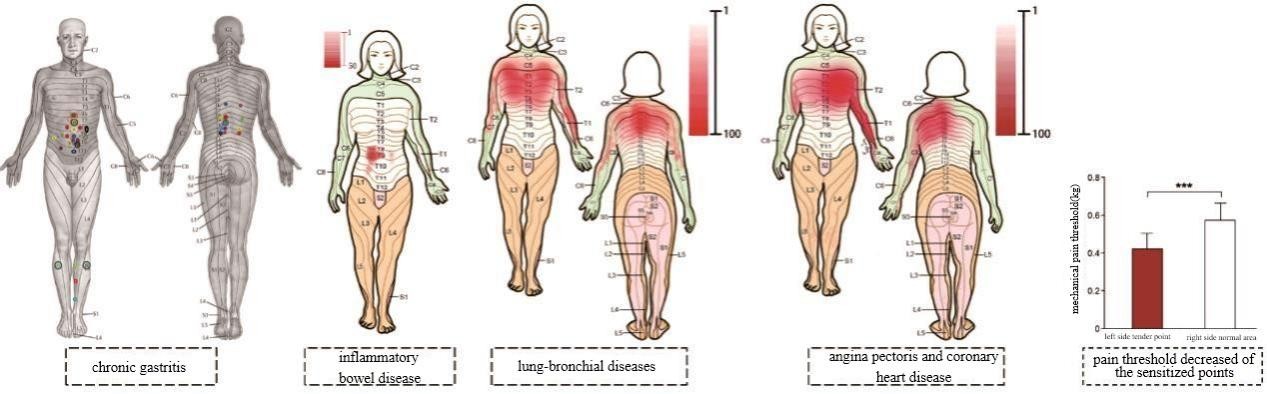
Occurrence of body surface sensitization in different diseases.
GA, UNITED STATES, April 4, 2026 /EINPresswire.com/ -- Acupoints have long been viewed as fixed locations for therapeutic stimulation, yet emerging evidence suggests they are dynamic biological sites that change with disease states. This review synthesizes decades of research to demonstrate that acupoints can become “sensitized” during visceral or inner disorders, exhibiting altered sensory thresholds, subcutaneous biochemical changes, and enhanced responsiveness to acupuncture like stimulation. These sensitized acupoints reflect underlying organ pathology while simultaneously serving as optimal sites for therapeutic intervention. By integrating diagnostic relevance with treatment efficacy, the concept of acupoint sensitization provides a unified framework for understanding how body surface changes mirror internal diseases and how acupuncture stimulation produce an amplified clinical effects through neurobiological mechanisms.
In both traditional acupuncture theory and modern medical experience, acupoints are central to therapeutic outcomes, yet their biological nature has remained controversial. Conventional models assume static point locations, which have contributed to inconsistencies in clinical trials and debates over placebo effects. Meanwhile, studies of referred pain, neurogenic inflammation, and somato-visceral reflexes suggest that disease can dynamically reshape sensory processing on the body surface. Observations such as tenderness, temperature changes, and altered pain thresholds at specific sites point toward a more flexible, state-dependent view of acupoints. Based on these challenges and unresolved questions, in-depth investigation into the mechanisms and clinical significance of acupoint sensitization is required.
Researchers from the Institute of Acupuncture and Moxibustion at the China Academy of Chinese Medical Sciences report new insights into the biological basis of acupoint sensitization in a review published in Acupuncture Research in May 2025. The article examines how visceral diseases induce functional and structural changes at specific body-surface sites, acupoints, and transforming them into sensitive diagnostic indicators and highly responsive therapeutic targets. By integrating clinical observations with advances in neurobiology, the review clarifies how sensitized acupoints link disease detection and treatment efficacy within acupuncture practice.
The author systematically reviews clinical and animal study evidences demonstrating that acupoint sensitization arises from somato-visceral neural anatomy connections. Visceral pathology activates spinal segments shared with corresponding body-surface regions, triggering neurogenic inflammation characterized by mast cell accumulation, neuropeptide release, and microcirculatory changes. These processes create localized “sensitization pools” that manifest as pain hypersensitivity, thermal changes, or morphological alterations.
Large-scale clinical investigations involving over 12,000 patients reveal consistent patterns linking specific diseases—such as coronary heart disease, functional gastrointestinal disorders, and pulmonary dysfunction—to reversible distributions of sensitized acupoints. Experimental studies further show that stimulating sensitized acupoints produces stronger biological effects than stimulating non-sensitized sites, including enhanced autonomic activities and improved organ functions.
Mechanistically, the review highlights peripheral and central sensitization pathways involving dorsal root ganglia sympathetic–sensory coupling, axonal reflex, dorsal root reflex and spinal dorsal horn neuronal sensitization etc. Advanced techniques such as in vivo calcium imaging demonstrate that visceral inflammation amplifies neural responsiveness in corresponding somatic regions. Importantly, the author emphasize that acupoint sensitization does not negate conventional point selection rules; and whether the acupoint is sensitized or not, somatic stimulation evokes autonomic regulations via sympathetic or parasympathetic somato-visceral reflexes. Rather, acupoint sensitization refines clinical decision-making by identifying sensitized sites where therapeutic signals are biologically amplified.
“Acupoint sensitization represents a shift from viewing acupoints as static landmarks to understanding them as dynamic biological interfaces,” the author notes. “These sites respond adaptively to pathological changes within the body, providing both diagnostic clues and optimized somatic sites for intervention.” The author emphasizes that sensitized acupoints symbolize the body’s self-regulatory instinct, where minor external stimulation can elicit disproportionately large physiological effects. This perspective offers a scientific explanation for long-standing clinical practices such as selecting tender or reactive points during acupuncture treatment.
The concept of acupoint sensitization has important implications for clinical research, diagnostics, and personalized therapy. By incorporating sensitization status into study design, future trials may better distinguish true therapeutic effects from non-specific responses. Clinically, identifying sensitized acupoints could enhance treatment precision and efficacy across a range of visceral disorders. Beyond acupuncture, this framework also contributes to broader neuroscience by illustrating how internal disease states reshape sensory processing and autonomic regulation. Ultimately, recognizing acupoints as dynamic, state-dependent structures may help bridge traditional medical practices with modern systems biology and neurophysiology.
References
DOI
10.13702/j.1000-0607.20250250
Original Source URL
https://dx.doi.org/10.13702/j.1000-0607.20250250
Funding Information
This work was supported by the National Natural Science Foundation of China (Key Program, No. 82330127) and the National Natural Science Foundation of China (Special Program, No. 82441060).
Lucy Wang
BioDesign Research
email us here
Legal Disclaimer:
EIN Presswire provides this news content "as is" without warranty of any kind. We do not accept any responsibility or liability for the accuracy, content, images, videos, licenses, completeness, legality, or reliability of the information contained in this article. If you have any complaints or copyright issues related to this article, kindly contact the author above.
