

Salmon Protein Hydrolysate Market Forecast 2026-2036: Global Market to Reach USD 740.0 Million by 2036 at 10.0% CAGR
Salmon Protein Hydrolysate Market
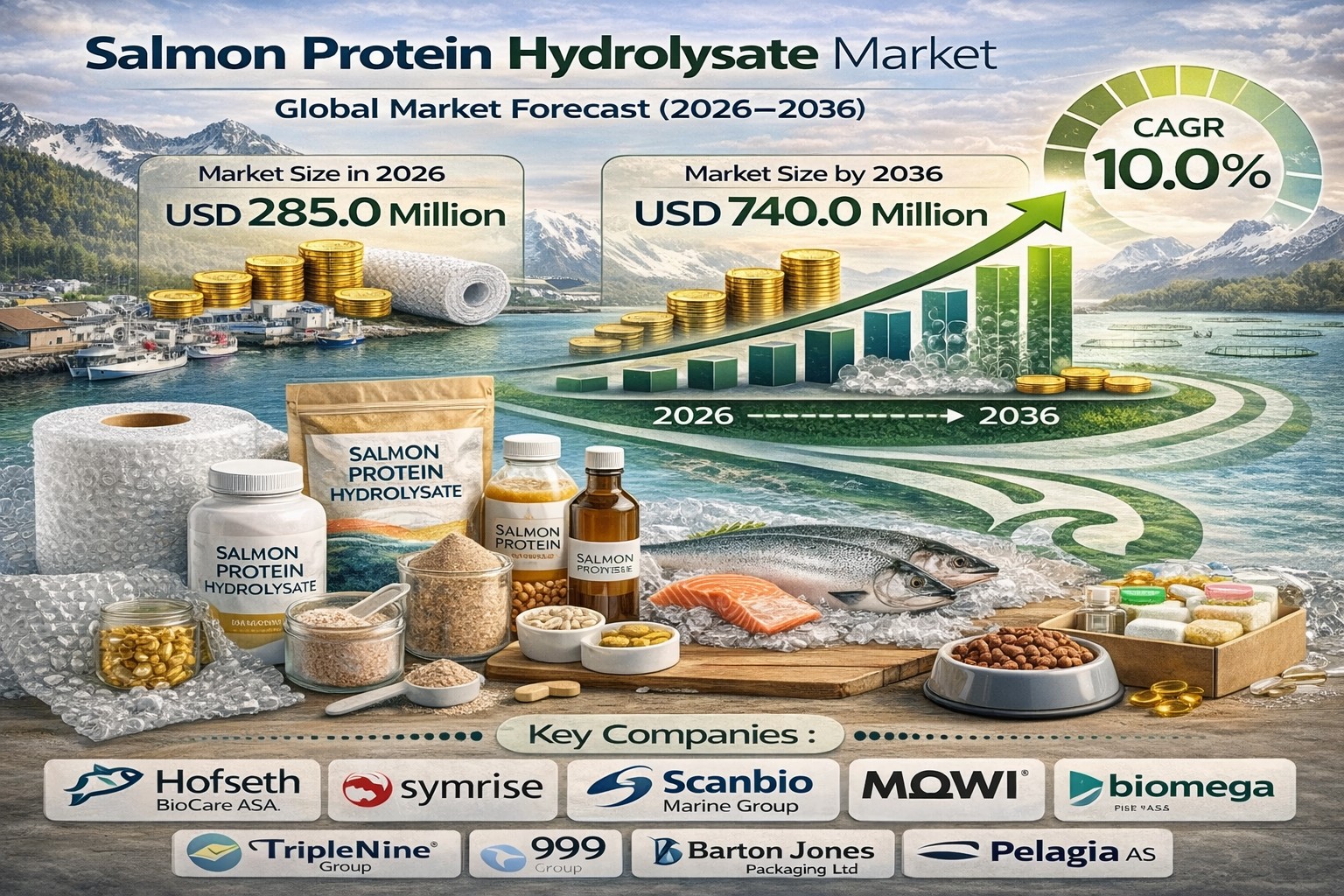
The salmon protein hydrolysate market is expected to grow at USD 285.0 million in 2026 and USD 740.0 million by 2036.
NEW YORK, DE, UNITED STATES, March 2, 2026 /EINPresswire.com/ -- The Salmon Protein Hydrolysate Market surpassed USD 260.0 million in 2025, is estimated at USD 285.0 million in 2026, and is forecast to reach USD 740.0 million by 2036, advancing at a robust 10.0% CAGR. Growth reflects accelerating demand for rapid-absorption marine peptides across clinical nutrition, sports formulations, and premium functional foods.
As adult demographics prioritize faster amino acid uptake over intact protein mass, formulation teams are substituting conventional concentrates with pre-digested peptide systems. The Salmon Protein Hydrolysate Market is transitioning from niche marine extraction to a standardized, performance-driven nutrition ingredient category.
• Market size in 2025 USD 260.0 million
• Market size in 2036 USD 740.0 million
• CAGR (2026–2036) 10.0%
• Leading product form Powder Hydrolysate – 53%
• Leading application Functional Foods & Beverages – 32%
• Key growth regions North America, Europe, Asia Pacific
• Fastest-growing country India – 12.0% CAGR
• Top companies Hofseth BioCare ASA; Symrise AG; Scanbio Marine Group; Mowi ASA; Biomega Group; Copalis Sea Solutions; TripleNine Group; Pelagia AS
Market Momentum (YoY Path):
The Salmon Protein Hydrolysate Market progresses from USD 260.0 million in 2025 to USD 285.0 million in 2026, before accelerating toward USD 740.0 million by 2036. Demand expansion aligns with increasing global aquaculture production, which reached 223.2 million tonnes in 2022, reshaping ingredient sourcing from waste management toward premium nutrition extraction. Growth concentrates across India (12.0%), China (11.2%), United States (10.4%), United Kingdom (9.8%), Germany (9.5%), and Brazil (9.1%), where aquaculture scale intersects with high-performance nutrition demand. Procurement teams secure long-term supply contracts to mitigate volatility in whole-fish pricing and stabilize hydrolysate feedstock economics.
Why the Market is Growing
The Salmon Protein Hydrolysate Market is expanding due to three structural shifts: rising clinical nutrition demand for rapid-absorption peptides, sustainability mandates encouraging biomass upcycling, and procurement strategies favoring high-margin marine ingredients over volatile agricultural protein isolates. Aquaculture operators convert secondary harvest biomass into enzymatically cleaved protein fractions, capturing additional value while insulating operations from whole-fish price swings. Clean-label mandates further accelerate adoption as brands prioritize traceable marine sourcing and natural peptide profiles.
Segment Spotlight:
Powder Hydrolysate Commands 53%
Powder formulations account for 53% of total industry volume in 2026, supported by spray-drying investments that stabilize amino acid profiles and extend shelf life. Transport economics favor dehydrated formats because removing water weight lowers freight costs and improves landed margins. Powders integrate seamlessly into dry sports nutrition and functional beverage production lines. In contrast, liquid variants face higher transport costs and bacterial degradation risks, prompting procurement teams to standardize on dry formats for global shipping.
Functional Foods & Beverages Capture 32%
Functional Foods & Beverages represent 32% of total demand in 2026, reflecting growing incorporation of marine peptides into mainstream nutrition products. Ready-to-drink beverages and fortified protein bars increasingly feature hydrolyzed marine proteins positioned around targeted wellness claims. Brands prioritize ingredients supported by clinical substantiation to secure premium retail shelf space. Peptide solubility enables integration into clear beverages without compromising taste or visual clarity, addressing consumer fatigue associated with pill-based supplementation.
Get Access of Report Sample: https://www.futuremarketinsights.com/reports/sample/rep-gb-32126
Drivers, Restraints, and Opportunities
• Drivers: Upcycling of salmon processing by-products transforms low-value biomass into premium nutritional extracts. Clinical nutrition and sports applications prioritize rapid amino acid absorption, accelerating substitution of intact proteins with enzymatically cleaved peptides.
• Restraints: Production costs remain higher than plant-based isolates due to specialized bioreactors and controlled enzymatic cleavage. Feedstock competition intensifies as 51% of aquatic animal production stems from aquaculture, increasing raw material pricing pressure.
• Opportunities: Cosmetic convergence expands revenue beyond ingestion channels, with marine peptides incorporated into topical applications. Aquafeed optimization integrates hydrolysates to improve yield and stress resistance in intensive farming systems. Export certification alignment strengthens trade competitiveness.
• Trends: Marine peptide standardization and batch-level profiling emerge as competitive differentiators. Investment in clinical validation and traceable aquaculture sourcing strengthens brand credibility and procurement preference.
Competitive Landscape
The Salmon Protein Hydrolysate Market is shaped by vertically integrated aquaculture operators and marine ingredient specialists. Strategic alliances secure offtake volumes and shorten qualification cycles for formulators. Hofseth BioCare ASA strengthens global distribution through exclusive agreements targeting key accounts. Symrise AG leverages sustainability-driven adoption pathways in aquafeed and human nutrition segments. Scanbio Marine Group, Mowi ASA, Biomega Group, Copalis Sea Solutions, TripleNine Group, and Pelagia AS compete through scale, upstream control, and peptide standardization capabilities. Vertical integration remains critical, as upstream harvest volumes directly influence feedstock economics and plant utilization rates.
FAQ
What is the projected value of the Salmon Protein Hydrolysate Market by 2036?
USD 740.0 million.
What was the market size in 2025?
USD 260.0 million.
What is the forecast CAGR from 2026 to 2036?
10.0%.
Which product form leads the market?
Powder Hydrolysate with 53% share.
Which application holds the highest share?
Functional Foods & Beverages at 32%.
Which country is growing the fastest?
India at 12.0% CAGR.
Why FMI: https://www.futuremarketinsights.com/why-fmi
Have a Look at Related Research Reports on the Food and Beverage Domain:
Protein Hydrolysate Ingredient Market: https://www.futuremarketinsights.com/reports/protein-hydrolysate-ingredient-market
Quinoa Protein Hydrolysate Market: https://www.futuremarketinsights.com/reports/quinoa-protein-hydrolysate-market
Pumpkin Seed Protein & Fiber Market: https://www.futuremarketinsights.com/reports/pumpkin-seed-protein-and-fiber-market
About Future Market Insights (FMI)
Future Market Insights, Inc. (FMI) is an ESOMAR-certified, ISO 9001:2015 market research and consulting organization, trusted by Fortune 500 clients and global enterprises. With operations in the U.S., UK, India, and Dubai, FMI provides data-backed insights and strategic intelligence across 30+ industries and 1200 markets worldwide.
Sudip Saha
Future Market Insights Inc.
+1 347-918-3531
email us here
Legal Disclaimer:
EIN Presswire provides this news content "as is" without warranty of any kind. We do not accept any responsibility or liability for the accuracy, content, images, videos, licenses, completeness, legality, or reliability of the information contained in this article. If you have any complaints or copyright issues related to this article, kindly contact the author above.
