

Recarburizers Market Forecast 2026–2036: Market to Reach USD 3.9 Billion by 2036 at 4.9% CAGR | FMI Analysis
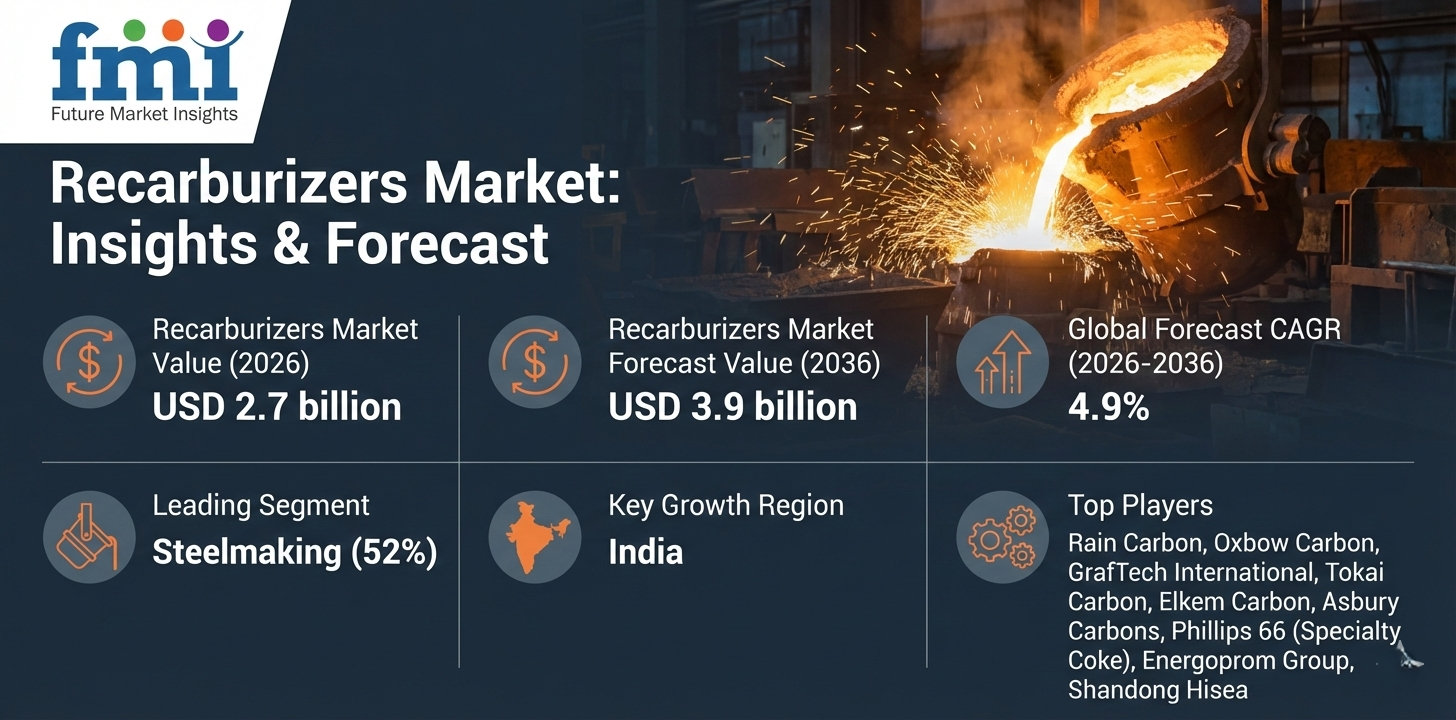
Rising steel production, EAF adoption, and demand for high-purity carbon additives drive steady global market expansion
NEWARK, DE, UNITED STATES, February 26, 2026 /EINPresswire.com/ -- The global Recarburizers Market is valued at USD 2.7 billion in 2026 and is projected to reach USD 3.9 billion by 2036, expanding at a CAGR of 4.9% from 2026 to 2036. Growth is supported by sustained demand from steelmaking and foundry industries, increasing electric arc furnace (EAF) utilization, and tightening quality standards for carbon control in metal production.
As metallurgical processes evolve toward higher precision and cleaner production, recarburizers are transitioning from commodity carbon additives into performance-critical inputs that directly influence tensile strength, hardness, and metallurgical consistency across steel and cast iron applications.
Recarburizers Market Snapshot (2026–2036)
• Market size in 2026: USD 2.7 billion
• Market size in 2036: USD 3.9 billion
• CAGR (2026–2036): ~4.9%
• Leading product type: Calcined Petroleum Coke (CPC)
• Top application segment: Steelmaking (52% share)
• Fastest-growing country: India (5.8% CAGR)
• Key companies: Rain Carbon, Oxbow Carbon, GrafTech International, Tokai Carbon, Elkem Carbon, Asbury Carbons, Phillips 66 (Specialty Coke), Energoprom Group, Shandong Hisea
Market Momentum
The recarburizers market begins at USD 2.7 billion in 2026, supported by expanding steel output and increasing reliance on electric arc furnaces. Between 2026 and 2028, the market experiences gradual acceleration, reaching approximately USD 2.9 billion as infrastructure investments and automotive manufacturing sustain steel demand.
Post-2028, the market enters a stabilization phase, with steady but moderated annual gains as industries optimize carbon input efficiency and adopt improved process controls. By 2032, the market reaches nearly USD 3.6 billion, eventually climbing to USD 3.9 billion by 2036. This growth pattern reflects cyclical steel demand combined with long-term capital investments in metallurgical quality improvement.
Request For Sample Report | Customize Report |purchase Full Report - https://www.futuremarketinsights.com/reports/sample/rep-gb-30899
Why the Market is Growing
The primary driver of the recarburizers market is the need for precise carbon adjustment in molten metal during steelmaking and foundry operations. Recarburizers—carbon-rich additives derived from petroleum coke, graphite, or synthetic materials—ensure accurate carbon levels in steel and cast iron, directly influencing mechanical properties and casting performance.
Increasing scrap recycling rates are amplifying demand. Scrap metal often presents inconsistent chemistry, requiring controlled recarburization to restore optimal carbon content. Meanwhile, the global shift toward electric arc furnace (EAF) technology, favored for energy efficiency and lower emissions compared to blast furnaces, further strengthens demand for high-purity recarburizers.
Additionally, infrastructure development and automotive production in emerging economies continue to require high-strength, durable steel grades—fueling sustained demand for reliable carbon correction materials.
Segment Spotlight
1. Application: Steelmaking Leads Demand
Steelmaking accounts for approximately 52% of total market share. Precise carbon control is essential in EAF and ladle refining processes to achieve desired strength, ductility, and hardness characteristics. As global steel production remains central to construction, transportation, and heavy industry, steelmaking continues to anchor recarburizer demand.
2. Product Type: Calcined Petroleum Coke (CPC) Dominates
CPC represents nearly 48% of product demand due to its high carbon content, low sulfur levels, and cost-effectiveness. Its consistent quality and strong carbon recovery rates make it the preferred choice for steel and cast iron applications.
3. Carbon Content Trends: Shift Toward Higher Purity
There is increasing demand for recarburizers with carbon content above 95%, particularly in high-performance steel applications. Higher purity grades improve recovery efficiency while reducing slag volume and impurity introduction.
Drivers, Opportunities, Trends, Challenges
Drivers:
• Expansion of global steel production
• Growth of EAF steelmaking
• Rising infrastructure and automotive demand
Opportunities:
• Development of high-purity and synthetic graphite recarburizers
• Expansion in emerging economies
• Process optimization technologies improving carbon recovery rates
Trends:
• Increasing preference for low-sulfur, high-carbon materials
• Focus on cost efficiency and carbon yield optimization
• Growing interest in alternative and biomass-based carbon sources
Challenges:
• Volatility in petroleum coke prices
• Environmental regulations on carbon-intensive inputs
• Potential long-term shift toward alternative low-carbon steel technologies
Country Growth Outlook (2026–2036)
India leads market expansion at a projected 5.8% CAGR, driven by rapid growth in steel production and infrastructure development. China follows at 5.5%, supported by its position as the world’s largest steel producer. Vietnam (5.1%) and Indonesia (4.9%) benefit from expanding manufacturing bases and industrial modernization. Mexico grows at 4.6%, supported by its strengthening automotive and construction sectors.
Competitive Landscape
The recarburizers market features established global suppliers competing on carbon purity, recovery efficiency, and cost control. Leading players include:
• Rain Carbon
• Oxbow Carbon
• GrafTech International
• Tokai Carbon
• Elkem Carbon
• Asbury Carbons
• Phillips 66 (Specialty Coke)
• Energoprom Group
• Shandong Hisea
Competition centers on delivering high-purity carbon materials with stable particle size distribution, predictable recovery rates, and compliance with tightening environmental standards. Strategic investments focus on feedstock security, production efficiency, and expansion in high-growth Asian markets.
Frequently Asked Questions (FAQ)
What is the global Recarburizers Market size?
The market is valued at USD 2.7 billion in 2026 and is projected to reach USD 3.9 billion by 2036.
At what rate is the market expected to grow?
The market is forecast to expand at a CAGR of approximately 4.9% from 2026 to 2036.
What are recarburizers used for?
Recarburizers are carbon additives used to adjust and restore carbon content in molten steel and cast iron during metallurgical processes.
Why is steelmaking the largest segment?
Steelmaking requires precise carbon control to achieve targeted mechanical properties, making recarburizers essential in EAF and refining operations.
Explore More Related Studies Published by FMI Research:
Agricultural Chelates Market https://www.futuremarketinsights.com/reports/agricultural-chelates-market
Fragrance Fixatives Market https://www.futuremarketinsights.com/reports/fragrance-fixatives-market
High-Strength Polyester Thread Market https://www.futuremarketinsights.com/reports/high-strength-polyester-thread-market
About Future Market Insights (FMI)
Future Market Insights (FMI) is a leading provider of market intelligence and consulting services, serving clients in over 150 countries. Headquartered in Delaware, USA, with a global delivery center in India and offices in the UK and UAE, FMI delivers actionable insights to businesses across industries including automotive, technology, consumer products, manufacturing, energy, and chemicals.
Why Choose FMI: https://www.futuremarketinsights.com/why-fmi
Sudip Saha
Future Market Insights Inc.
+1 347-918-3531
rahul.singh@futuremarketinsights.com
Legal Disclaimer:
EIN Presswire provides this news content "as is" without warranty of any kind. We do not accept any responsibility or liability for the accuracy, content, images, videos, licenses, completeness, legality, or reliability of the information contained in this article. If you have any complaints or copyright issues related to this article, kindly contact the author above.
