

Biochar-Infused Sustainable Cement Additives Market Forecast 2026-2036: Market to Reach USD 480 Million by 2036
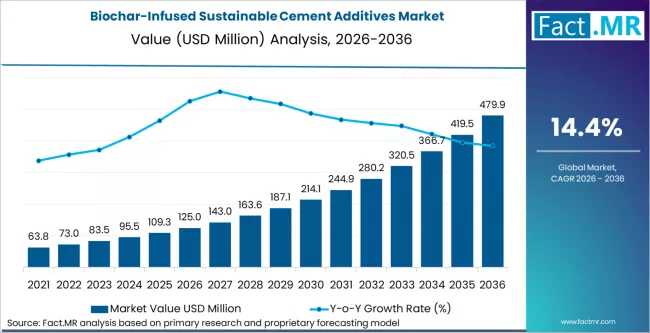
Biochar-Infused Sustainable Cement Additives Market
Biochar Blends are expected to dominate with a 52% market share by 2026; Ready-Mix Concrete applications are projected to capture 45% of the market.
UNITED STATES, MD, UNITED STATES, February 25, 2026 /EINPresswire.com/ -- The global biochar-infused sustainable cement additives market is projected to reach a valuation of USD 125 million in 2026, expanding significantly to USD 480 million by 2036. This growth, characterized by a CAGR of 14.4%, is fueled by the construction industry’s urgent shift toward low-carbon materials and carbon sequestration technologies. As regulatory pressures mount, biochar-based additives are emerging as a critical solution for enhancing material strength while reducing the environmental footprint of global infrastructure.Get Access Report Sample : https://www.factmr.com/connectus/sample?flag=S&rep_id=14360
Quick Stats for Biochar-Infused Sustainable Cement Additives Market
Market size 2026? Estimated at USD 125 million.
Market size 2036? Projected to reach USD 480 million.
CAGR? A steady compound annual growth rate of 14.4% from 2026 to 2036.
Leading product segment(s) and shares? Biochar Blends are expected to dominate with a 52% market share by 2026; Ready-Mix Concrete applications are projected to capture 45% of the market.
Leading material type and share? Biochar Blends lead the market with a 52% share.
Leading end use and share? Residential Construction is the primary end-use sector, accounting for 40% of the market share.
Key growth regions? Australia, USA, Germany, and China are identified as the primary growth engines.
Top companies? Carbon8 Systems Ltd., Bioforcetech Corporation, Black Bear Carbon B.V., Airex Energy Ltd., and Pacific Biochar.
Market Momentum (YoY Path)
The biochar-infused sustainable cement additives market is set for a decade of consistent value appreciation. Following its USD 125 million valuation in 2026, the market is expected to climb to USD 164.7 million by 2028 and reach USD 216.7 million by 2030. Accelerating adoption will push values to USD 248 million in 2031 and USD 325.2 million by 2033. By the end of the forecast period in 2036, the market is anticipated to settle at USD 480 million, representing an absolute dollar growth of USD 355 million from its 2026 baseline.
Why the Market is Growing
The primary catalyst for expansion is the increasing demand for eco-friendly and sustainable building materials that offer carbon sequestration benefits. Biochar-infused additives refine the microstructure of cement, improving durability and workability while lowering the overall carbon footprint. Furthermore, rising adoption of carbon-negative alternatives in concrete production is helping the industry meet stringent environmental standards and green building benchmarks like LEED.
Segment Spotlight
1) Material Type: Biochar Blends (52%)
Biochar blends are projected to capture over half the market by 2026. These engineered formulations combine biochar with other materials to enhance cement performance and sustainability. By providing a carbon-negative alternative to traditional chemical additives, these blends improve the environmental profile of construction projects while remaining cost-effective for manufacturers.
2) Application: Ready-Mix Concrete (45%)
Ready-mix concrete stands as the leading application segment. The integration of biochar-infused additives into ready-mix formulations enhances thermal insulation, mechanical strength, and cracking resistance. This is particularly vital for large-scale infrastructure and commercial projects seeking to meet performance and sustainability goals simultaneously.
3) End Use: Residential Construction (40%)
The residential sector is the strongest driver for these additives, supported by increasing consumer demand for sustainable housing. As eco-friendly building materials become a priority for homeowners and developers, the use of biochar to improve the quality and longevity of residential concrete structures continues to rise.
Drivers, Opportunities, Trends, Challenges
Low-Carbon Materials Demand: The industry is witnessing a structural shift where traditional pozzolans are being replaced by biochar-enhanced additives. This trend is driven by the specific requirement for carbon-reducing materials in green building and infrastructure projects to meet strict sustainability benchmarks.
Regulatory Standards Pressure: International standards, such as the EU’s Construction Products Regulation and LEED certification, are pushing the adoption of certified low-carbon systems. This creates a significant opportunity for biochar-infused formulations that provide measurable carbon reduction and improved material microstructure.
Regional Construction Trends: Adoption rates vary significantly by geography. In North America and Europe, strong carbon-neutral targets and green procurement policies are accelerating market uptake. Meanwhile, rapid urbanization in East Asia provides a high-volume growth environment for sustainable building technologies.
Production and Scalability Challenges: Despite high demand, the market faces hurdles regarding high production costs and the complexities of scaling biochar production. Improving cost-efficiency in manufacturing remains a primary challenge for stakeholders looking to make these additives more accessible across cost-sensitive projects.
Country Growth Outlook (CAGR)
Country CAGR (2026-2036)
Australia 16.5%
USA 14.8%
Germany 13.2%
China 12.5%
Competitive Landscape
Key market participants are focusing on technological innovation to differentiate their offerings. Carbon8 Systems Ltd., Bioforcetech Corporation, and Black Bear Carbon B.V. are leveraging advanced pyrolysis and formulation techniques to enhance cement performance. Meanwhile, Airex Energy Ltd. and Pacific Biochar emphasize sustainable manufacturing and carbon capture capabilities. Recent corporate movements, such as Holcim's mainstreaming of biochar-infused concrete and Sagar Cements' 10-year pact with Sow & Reap Chara, signal a shift toward long-term industrialization and carbon-sink integration.
Related Report
https://www.factmr.com/report/sustainable-aqueous-film-forming-foams-market - Sustainable Aqueous Film-Forming Foams Market
https://www.factmr.com/report/sustainable-pharmaceutical-packaging-market - Sustainable Pharmaceutical Packaging Market
https://www.factmr.com/report/sustainable-apparel-market - Sustainable Apparel Market - Sustainable Apparel Market
https://www.factmr.com/report/green-antifouling-coatings-for-ships-biocide-free-market - Green Antifouling Coatings for Ships (Sustainable) Market
https://www.factmr.com/report/pvc-additives-market - PVC Additives Market
https://www.factmr.com/report/3918/tire-additives-market - Tire additives Market
About Fact.MR
Fact.MR is a global market research and consulting firm, trusted by Fortune 500 companies and emerging businesses for reliable insights and strategic intelligence. With a presence across the U.S., UK, India, and Dubai, we deliver data-driven research and tailored consulting solutions across 30+ industries and 1,000+ markets. Backed by deep expertise and advanced analytics, Fact.MR helps organizations uncover opportunities, reduce risks, and make informed decisions for sustainable growth.
S. N. Jha
Fact.MR
+1 628-251-1583
email us here
Legal Disclaimer:
EIN Presswire provides this news content "as is" without warranty of any kind. We do not accept any responsibility or liability for the accuracy, content, images, videos, licenses, completeness, legality, or reliability of the information contained in this article. If you have any complaints or copyright issues related to this article, kindly contact the author above.
