

Turret System Market to Reach USD 27.36 Billion by 2034, Registering a CAGR of 3.17% (2026-2034)
Turret System Market
The market, valued at USD 20.79 billion in 2025, is set for steady growth as nations invest in advanced combat vehicles and upgraded turret technologies.
Ongoing military modernization, rising geopolitical tensions, and increased defense spending are driving demand for next-generation turret systems, with North America holding the leading share.”
PUNE, MAHARASHTRA, INDIA, February 10, 2026 /EINPresswire.com/ -- The global turret system market is undergoing steady transformation as defense forces worldwide accelerate modernization, adopt autonomous combat systems, and prioritize modular weapon platforms. The market was valued at USD 20.79 billion in 2025 and is projected to grow from USD 21.31 billion in 2026 to USD 27.36 billion by 2034, registering a CAGR of 3.17% during the forecast period. North America dominated the global market with a 34.06% share in 2025, driven by strong defense budgets and continuous modernization of armored and naval fleets.— Fortune Business Insights
Turret systems including weapon mounts, remote weapon stations, and sensor-integrated platforms play a critical role in enhancing precision, protection, and situational awareness across land, naval, and airborne domains. Countries are increasingly replacing hydraulic and manually operated turrets with electro-mechanical, AI-assisted, and stabilized systems capable of engaging diverse threats such as drones, armored vehicles, and low-flying targets. Rising geopolitical tensions, particularly in Europe and Asia Pacific, are driving procurement programs and joint production initiatives.
Request Free Sample PDF: https://www.fortunebusinessinsights.com/enquiry/request-sample-pdf/turret-system-market-114384
Russia–Ukraine War Impact
Conflict-Driven Acceleration in Defense Modernization
The Russia–Ukraine conflict has significantly reshaped the turret system market by accelerating procurement and modernization cycles worldwide. The war has demonstrated the importance of armored vehicles, remote weapon stations, and stabilized turrets in high-intensity, drone-saturated battlefields.
NATO countries and European allies have increased defense budgets, fast-tracked vehicle replacement programs, and reactivated dormant manufacturing lines. The U.S., Germany, Poland, the U.K., and South Korea have recorded rising orders for modular, electric, and remote-controlled turret systems.
Market Drivers
Defense Modernization and Geopolitical Tensions
The primary driver of turret system demand is the global wave of defense modernization triggered by rising geopolitical tensions. Countries across Europe, Asia, and the Middle East are replacing legacy hydraulic turrets with digital, electric, and stabilized systems capable of operating in electronic warfare environments.
Increasing defense budgets in the U.S., Germany, India, and China are fueling procurement of next-generation armored vehicles, naval guns, and UAV-mounted turret platforms. The focus on crew protection, precision lethality, and multi-domain operations is accelerating adoption of remote weapon stations and unmanned turrets.
Market Opportunities
Growth of Unmanned, Retrofit, and Export Segments
Significant opportunities exist in unmanned and retrofit turret systems, as well as exports to developing defense markets. Many militaries are prioritizing crew safety and precision engagement, increasing demand for remotely operated and AI-assisted turrets.
Retrofitting older armored vehicles and patrol ships with modern electric or sensor-fused turrets provides a cost-effective alternative to full platform replacement. This is creating a large upgrade market across Europe, Asia, and the Middle East.
Emerging defense producers in India, South Korea, and Türkiye are also targeting export opportunities by developing cost-competitive, indigenously manufactured turret systems. The rise of UAV-mounted and small-caliber turret systems for surveillance and counter-drone missions is opening new growth avenues in the aerospace segment.
Market Trends
Electrification, Autonomy, and Modular Integration
A key trend shaping the market is the shift toward electrified, intelligent, and modular turret architectures. Traditional hydraulic systems are being replaced by electric and electro-mechanical drives that offer improved reliability, reduced maintenance, and easier integration with digital fire-control systems.
AI-enabled targeting, sensor fusion, and stabilized optics are transforming turrets into sophisticated, networked combat subsystems. Modular designs allow rapid reconfiguration between gun, missile, or surveillance roles, extending platform lifespans and reducing lifecycle costs.
Remote and unmanned turrets are also gaining popularity, especially in armored vehicles and UAVs, as they enhance crew survivability. Cybersecurity and digital standardization are becoming critical design considerations as defense forces transition toward network-centric warfare.
Market Challenges
Cybersecurity Risks and Technological Transition
As turret systems evolve into digital, networked platforms, cybersecurity risks are becoming a major concern. AI-driven targeting and sensor fusion increase system complexity and potential cyber vulnerabilities.
Achieving interoperability between systems from different OEMs and nations remains another challenge, particularly in multinational defense coalitions. Additionally, replacing hydraulic mechanisms with electric drives requires extensive redesign and long certification cycles.
The rapid evolution of battlefield threats, including drones and directed-energy weapons, is forcing turret manufacturers to adapt quickly while balancing innovation, reliability, and affordability.
Segmentation Analysis
By Platform
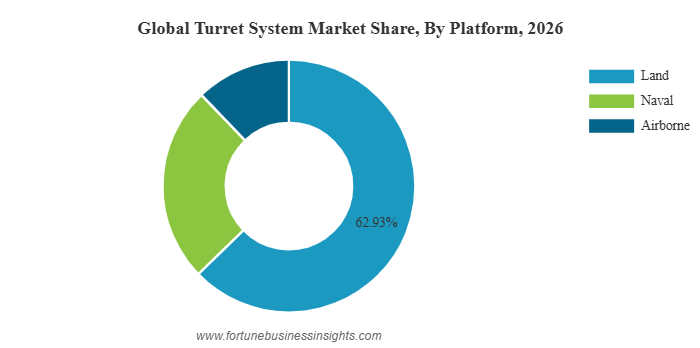
The market is segmented into land, naval, and airborne platforms.
The land segment dominates, accounting for 62.93% share in 2026, driven by modernization of armored vehicles and infantry fighting vehicles.
By Technology
Segments include hydraulic, electric/electro-mechanical, hybrid, and sensor-based systems.
The electric/electro-mechanical segment leads with a 42.98% share in 2026, due to its efficiency, reliability, and compatibility with autonomous platforms.
By Deployment Mode
The market includes vehicle-mounted, naval hull, stationary, and drone-mounted turrets.
The vehicle-mounted segment leads with a 58.19% share in 2026, supported by demand for mobile and modular combat systems.
By Weapon Type
Segments include small-caliber (≤30 mm), medium-caliber (30–50 mm), large-caliber, and missile-integrated systems.
The small-caliber segment dominates with a 30.55% share in 2026, driven by lightweight and unmanned applications.
By Component
Components include turret drives, fire-control electronics, stabilization systems, and others.
Turret control and fire-control electronics lead the segment, expected to hold 32.95% share in 2025, due to increasing adoption of AI and sensor fusion technologies.
Speak with Analysts: https://www.fortunebusinessinsights.com/enquiry/speak-to-analyst/turret-system-market-114384
Regional Insights:
North America
North America leads the market, driven by U.S. modernization programs for armored and naval platforms. The regional market reached USD 7.26 billion in 2026, with the U.S. accounting for the majority of demand.
Europe
Europe is experiencing strong growth due to rearmament programs following the Russia–Ukraine conflict. Germany, the U.K., Poland, and France are upgrading turret systems across land and naval
Asia Pacific
Asia Pacific is the fastest-growing region, fueled by defense modernization in India, China, South Korea, and Japan. Indigenous turret development and border tensions are driving investments across all platforms.
Competitive Landscape:
BAE Systems
Rheinmetall AG
Leonardo S.p.A.
Elbit Systems
General Dynamics
Northrop Grumman
Lockheed Martin
Moog Inc.
FN Herstal
Denel
Future Outlook:
The global turret system market is expected to grow steadily through 2034, driven by defense modernization, rising geopolitical tensions, and the shift toward autonomous combat systems. While high costs and integration challenges remain, the increasing adoption of electric, modular, and unmanned turrets is expected to reshape the market.
Ashwin Arora
Fortune Business Insights™ Pvt. Ltd.
+1 833-909-2966
sales@fortunebusinessinsights.com
Legal Disclaimer:
EIN Presswire provides this news content "as is" without warranty of any kind. We do not accept any responsibility or liability for the accuracy, content, images, videos, licenses, completeness, legality, or reliability of the information contained in this article. If you have any complaints or copyright issues related to this article, kindly contact the author above.
