

Smartphone Enabled Medical Devices Market is expected to reach US$ 89.15 billion by 2033 | DataM Intelligence
Smartphone Enabled Medical Devices Market
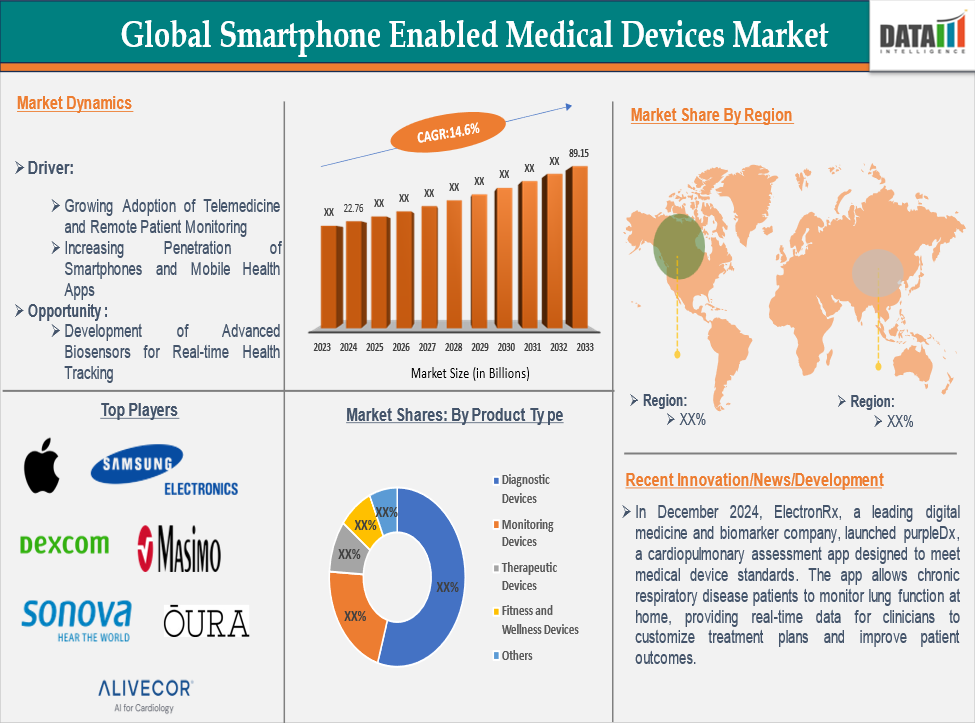
The Global Smartphone Enabled Medical Devices Market is expected to reach at a CAGR of 14.6% during the forecast period 2025-2033.
The Smartphone Enabled Medical Devices Market is rapidly growing, driven by mobile health adoption, wearable tech integration, and remote monitoring demand, boosting patient care and data insights.”
AUSTIN, TX, UNITED STATES, February 5, 2026 /EINPresswire.com/ -- Market Overview:— DataM Intelligence
The Smartphone Enabled Medical Devices Market is rapidly reshaping the global healthcare ecosystem by merging mobile technology with medical-grade diagnostics, monitoring, and therapeutic tools. These devices leverage smartphones as interfaces for data capture, analysis, storage, and real-time communication, allowing patients and healthcare providers to monitor health conditions with greater convenience and accuracy. From glucose meters and ECG monitors to smart inhalers and blood pressure devices, smartphone-enabled solutions are bridging the gap between traditional clinical settings and home-based care. The growing penetration of smartphones, combined with advancements in sensors, cloud connectivity, and mobile health (mHealth) applications, has made these devices more accessible and scalable across both developed and emerging economies.
To Download Sample Report Here: https://www.datamintelligence.com/download-sample/smartphone-enabled-medical-devices-market
According to DataM Intelligence, The Global Smartphone Enabled Medical Devices Market was valued at approximately USD 22.76 billion in 2024 and is projected to reach nearly USD 89.15 billion by 2033, growing at a compound annual growth rate (CAGR) of around 14.6% during the forecast period. The key growth drivers include the rising prevalence of chronic diseases, increasing demand for remote patient monitoring, growing adoption of telehealth services, and continuous innovation in mobile health technologies. Among product categories, diagnostic and monitoring devices currently lead the market due to their widespread use in chronic disease management. Geographically, North America dominates the market, supported by advanced healthcare infrastructure, high smartphone penetration, favorable reimbursement policies, and strong adoption of digital health solutions by both providers and patients.
Key Highlights from the Report:
The Smartphone Enabled Medical Devices Market is witnessing double-digit growth due to increasing chronic disease burden worldwide.
Diagnostic and monitoring devices represent the leading product segment owing to high adoption in homecare settings.
North America remains the dominant region, driven by strong digital health ecosystems and early technology adoption.
Integration of artificial intelligence and cloud-based analytics is enhancing device accuracy and clinical decision-making.
Growing demand for remote patient monitoring is accelerating adoption among hospitals and individual consumers.
Emerging markets in Asia-Pacific are expected to register the fastest growth during the forecast period.
Market Segmentation:
The Smartphone Enabled Medical Devices Market can be segmented based on product type, end-user, and application, each playing a crucial role in shaping market dynamics. By product type, the market includes diagnostic devices, monitoring devices, therapeutic devices, and wellness-focused devices. Diagnostic and monitoring devices, such as smartphone-connected ECGs, glucose meters, pulse oximeters, and blood pressure monitors, hold the largest share. Their dominance is attributed to the increasing need for continuous health tracking, early diagnosis, and proactive disease management, especially among patients with diabetes, cardiovascular disorders, and respiratory conditions.
Based on end-users, the market is segmented into hospitals and clinics, homecare settings, and individual consumers. Homecare settings represent a rapidly expanding segment as healthcare systems worldwide shift toward decentralized and patient-centric care models. Smartphone-enabled devices empower patients to manage their health independently while enabling clinicians to access real-time data remotely. Individual consumers are also increasingly adopting these devices for preventive care and wellness monitoring, driven by growing health awareness and the popularity of fitness and health apps.
In terms of application, the market spans cardiology, diabetology, respiratory care, neurology, and general wellness. Cardiology and diabetology applications account for a significant share due to the high prevalence of heart disease and diabetes globally. The integration of smartphone technology with medical devices allows seamless data sharing, improved adherence to treatment plans, and better long-term outcomes.
Speak to Our Analyst and Get Customization in the report as per your requirements: https://www.datamintelligence.com/customize/smartphone-enabled-medical-devices-market
Regional Insights:
From a regional perspective, North America continues to lead the smartphone enabled medical devices market. The region benefits from advanced healthcare IT infrastructure, strong investment in digital health innovation, and a high level of acceptance of remote monitoring solutions among patients and providers. The United States, in particular, has witnessed widespread adoption of smartphone-enabled ECGs, glucose monitors, and wearable health devices, supported by favorable regulatory frameworks and reimbursement policies.
Europe follows closely, driven by increasing government initiatives promoting digital health, rising geriatric populations, and growing awareness of preventive healthcare. Countries such as Germany, the UK, and France are actively integrating mHealth solutions into their healthcare systems to reduce hospital burden and improve patient outcomes.
The Asia-Pacific region is expected to experience the fastest growth over the forecast period. Rapid smartphone penetration, expanding middle-class populations, and increasing investments in healthcare infrastructure are key contributors. Emerging economies such as China and India are witnessing strong demand for affordable, smartphone-enabled diagnostic and monitoring devices, particularly in rural and underserved areas. Meanwhile, Latin America and the Middle East & Africa are gradually adopting these technologies as telemedicine and mobile healthcare initiatives gain traction.
Market Dynamics:
Market Drivers
The primary driver of the smartphone enabled medical devices market is the rising prevalence of chronic diseases such as diabetes, cardiovascular disorders, and respiratory illnesses. These conditions require continuous monitoring, making smartphone-enabled solutions highly valuable. Additionally, the growing adoption of telehealth and remote patient monitoring has significantly boosted demand, as healthcare providers seek cost-effective ways to manage patients outside traditional clinical environments. Technological advancements in sensors, wireless connectivity, and mobile applications further enhance device functionality and user experience, accelerating market growth.
Market Restraints
Despite strong growth prospects, the market faces certain restraints. Data privacy and cybersecurity concerns remain a major challenge, as smartphone-enabled devices collect and transmit sensitive health information. Regulatory complexities and varying approval requirements across regions can also delay product launches and increase development costs. Moreover, limited digital literacy among certain patient populations may hinder adoption, particularly in older age groups or low-income regions.
Market Opportunities
The Market presents significant opportunities through the integration of advanced technologies such as artificial intelligence, machine learning, and big data analytics. These innovations can enable predictive diagnostics, personalized treatment plans, and improved clinical decision-making. Expanding healthcare access in emerging markets, coupled with increasing investments in digital health startups, offers substantial growth potential. Partnerships between device manufacturers, app developers, and healthcare providers are also expected to unlock new revenue streams and application areas.
Looking For Full Report? Get it Here: https://www.datamintelligence.com/buy-now-page?report=smartphone-enabled-medical-devices-market
Frequently Asked Questions (FAQs):
How big is the Smartphone Enabled Medical Devices Market globally?
Who are the key players in the Global Smartphone Enabled Medical Devices Market?
What is the projected growth rate of the smartphone enabled medical devices market during the forecast period?
What is the market forecast for smartphone enabled medical devices by 2033?
Which region is estimated to dominate the industry through the forecast period?
Company Insights:
Key players operating in the Smartphone Enabled Medical Devices Market include:
Apple Inc
Samsung Electronics
DexCom, Inc
Masimo Corporation
Sonova Holding AG
Oura Health Ltd
Beurer GmbH
Medtronic
Abbott Laboratories
AliveCor, Inc
Recent Developments:
United States:
December 2025: Qualcomm announced a chipset for smartphone biosensors, enabling broader adoption in wearables for hypertension tracking.
November 2025: FDA approved a new smartphone-connected continuous glucose monitor from Dexcom, enhancing real-time diabetes management with AI-driven alerts for better patient outcomes. This built on prior models by integrating telehealth directly via apps.
October 2025: Apple launched an ECG-enabled smartwatch update with blood oxygen tracking, partnering with major hospitals for remote cardiac monitoring trials nationwide.
September 2025: Medtronic released a smartphone-linked insulin pump app, allowing users to adjust doses remotely, amid rising demand for home-based chronic disease care.
Japan:
December 2025: Government pilot for AI-enhanced smartphone oximeters began in Tokyo, promoting preventive care amid rising lifestyle diseases.
November 2025: Ministry of Health endorsed Omron's smartphone blood pressure monitor for nationwide insurance reimbursement, accelerating home monitoring for the aging population.
October 2025: Sony developed a pulse oximeter app integration for Android/iOS, focusing on sleep apnea detection with data synced to national health databases.
September 2025: Panasonic unveiled a wearable ECG device compatible with LINE app, targeting rural telehealth expansion in partnership with local clinics.
Unlock 360° Market Intelligence with DataM Subscription Services: https://www.datamintelligence.com/reports-subscription
Conclusion:
The Smartphone Enabled Medical Devices Market is poised for sustained growth as healthcare systems worldwide embrace digital transformation and patient-centric care models. By combining the ubiquity of smartphones with advanced medical technologies, these devices offer scalable, cost-effective, and accessible solutions for diagnosis, monitoring, and disease management. Strong growth drivers such as rising chronic disease prevalence, expanding telehealth adoption, and continuous technological innovation are expected to propel the market forward. As emerging regions accelerate adoption and advanced analytics reshape clinical applications, smartphone-enabled medical devices will play a pivotal role in the future of global healthcare delivery.
Related Reports:
Smart Medical Devices Market
Interventional Neurology Devices Market
Sai Kiran
DataM Intelligence 4Market Research
+1 877-441-4866
Sai.k@datamintelligence.com
Visit us on social media:
LinkedIn
X
Legal Disclaimer:
EIN Presswire provides this news content "as is" without warranty of any kind. We do not accept any responsibility or liability for the accuracy, content, images, videos, licenses, completeness, legality, or reliability of the information contained in this article. If you have any complaints or copyright issues related to this article, kindly contact the author above.
