

Global Freight Forwarding Market Size to Reach USD 536.51 Billion by 2034 | Growth Forecast 2026–2034
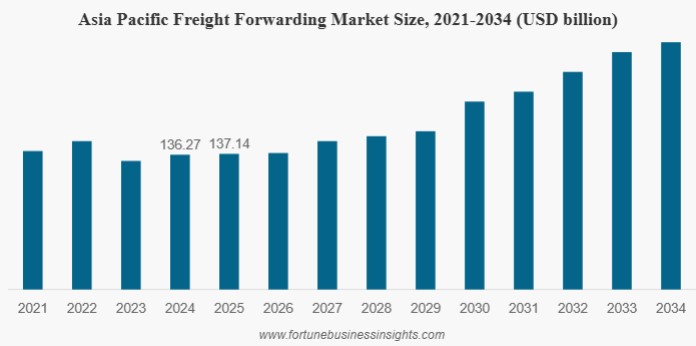
Freight Forwarding Market Size
The freight forwarding market is led by key companies such as DHL Global Forwarding, Kuehne+Nagel, DSV, Expeditors, CH Robinson, Nippon Express and more.
PUNE, MAHARASHTRA, INDIA, February 4, 2026 /EINPresswire.com/ -- Freight forwarding is a comprehensive logistics service that manages the movement of goods across domestic and international locations. Services include transportation booking, customs clearance, documentation, consolidation, warehousing, risk management, and ensuring timely, cost-efficient, and compliant deliveries. Freight forwarders optimize supply chains across various modes of transport including air, sea, road, and rail, providing end-to-end solutions for manufacturers, retailers, and other businesses.The global freight forwarding market has been witnessing significant growth, driven by rising international trade, e-commerce expansion, and the increasing demand for efficient, multimodal logistics solutions. According to Fortune Business Insights, the market size was valued at USD 325.18 billion in 2025 and is projected to grow from USD 336.61 billion in 2026 to USD 536.51 billion by 2034, exhibiting a CAGR of 6.0% during the forecast period. Asia Pacific dominated the market, accounting for 42.17% of the market share in 2025.
Get a Free Sample PDF -https://www.fortunebusinessinsights.com/enquiry/request-sample-pdf/freight-forwarding-market-114883
Key Market Drivers
Global Trade Expansion: Increasing international trade volumes boost demand for reliable freight forwarding services. Growth in manufacturing, regional production hubs, and cross-border operations creates the need for efficient cargo movement and supply chain coordination.
Technological Advancements: Adoption of digital platforms, AI-driven analytics, and cloud-based freight marketplaces enhances operational efficiency, transparency, and customer satisfaction, presenting major growth opportunities.
Multimodal Transport Demand: Rising demand for flexible transport options integrating air, sea, road, and rail reduces transit times and improves resilience against disruptions.
Market Restraints
Despite growth, the market faces challenges such as rising logistics costs, fuel price volatility, labor shortages, and port congestion. Small and mid-sized forwarders often struggle with limited bargaining power and high operational expenses. Additionally, fluctuating freight rates and decarbonization costs create financial pressures on market participants.
Emerging Opportunities
Digitalization in logistics presents transformational opportunities. Forwarders implementing automated documentation, predictive analytics, and real-time tracking gain competitive advantages. Cloud-based freight marketplaces improve carrier selection and optimize pricing. Notable examples include Nippon Express Holdings’ NX Lead Logistics Solutions, launched in May 2025, providing centralized order management, visibility across transport modes, and enhanced risk management.
Key Market Trends
Rise of Multimodal Logistics: Companies increasingly integrate air–sea, sea–rail, and road–rail transport to reduce costs, improve reliability, and manage disruptions efficiently. Gulftainer, for instance, expanded its multimodal network in September 2025 by opening new hubs and inland container depots.
International Freight Forwarding Dominance: Businesses expanding cross-border operations drive demand for international forwarding services. Compliance with customs regulations, tariffs, and global trade agreements strengthens this segment.
Air Freight Growth: Rapid delivery requirements, high-value shipments, and e-commerce expansion accelerate the adoption of air freight, complemented by improved cargo capacity and digital solutions.
Market Segmentation
By Mode of Transport
The freight forwarding market is segmented into air, waterways, road, and rail transport:
Waterways: Leading mode due to cost efficiency in transporting heavy and bulk cargo over long distances. Extensive port infrastructure and optimized shipping lanes reinforce its dominance.
Air Transport: Rapid deliveries of time-sensitive goods drive air freight growth, particularly in high-value and e-commerce shipments.
Road and Rail: Crucial for last-mile delivery and regional cargo movement, complementing global sea and air networks.
By Service Type
Services are categorized into domestic and international freight forwarding:
International Freight Forwarding: Dominates the market due to growing cross-border trade. Forwarders manage documentation, customs, tariffs, and provide end-to-end shipment visibility.
Domestic Freight Forwarding: Supports regional supply chains and short-haul cargo, important for time-sensitive delivery and localized logistics.
By Shipment Type
Forwarding services are divided into:
LCL/LTL (Less than Container/Truck Load): Efficient for smaller shipments, allowing cost-sharing across multiple customers.
FCL/FTL (Full Container/Truck Load): Suitable for large shipments, providing higher efficiency and reduced handling risks.
By Industry
Key industries driving freight forwarding demand include:
Manufacturing
Automotive
Pharmaceuticals & Healthcare
FMCG
Other industries requiring global supply chain solutions
Speak To Analyst-https://www.fortunebusinessinsights.com/enquiry/request-sample-pdf/freight-forwarding-market-114883
Competitive Landscape
The market is highly competitive with leading players focusing on network expansion, digitalization, and automation:
DHL Global Forwarding (Germany)
Kuehne+Nagel (Switzerland)
DSV (Denmark)
DB Schenker (Germany)
Expeditors International (U.S.)
CH Robinson (U.S.)
Nippon Express Holdings (Japan)
Kintetsu World Express (Japan)
Sinotrans (China)
CEVA Logistics (France)
Bolloré Logistics (France)
Regional Insights
Asia Pacific dominates with over 42% market share, supported by rapid industrialization, expanding e-commerce, and developing logistics infrastructure. Europe and North America maintain strong market positions with advanced supply chains, extensive port networks, and high adoption of digital logistics solutions. Emerging regions in Latin America and the Middle East are investing in multimodal transport hubs to enhance trade connectivity.
Key Industry Developments
In November 2025, Mahindra Logistics and L'Oréal India launched an all-women-operated warehouse in Indore, Madhya Pradesh. The facility supports distribution across central India, including cities like Jabalpur, Bhopal, and Singrauli. The initiative aims to improve replenishment cycles, reduce transit times, and enhance inventory control and fulfillment for L'Oréal’s products.
Future Market Scope
The global freight forwarding market is set to expand steadily, with growth driven by digital supply chain platforms, multimodal transport adoption, and international trade growth. Companies integrating AI, predictive analytics, and automated documentation are expected to gain competitive advantages, while investments in green logistics and infrastructure improvements will further drive market expansion. The market outlook remains positive, emphasizing efficiency, speed, cost-effectiveness, and technological innovation.
Conclusion
The freight forwarding market represents a critical component of the global logistics ecosystem. With increasing cross-border trade, e-commerce proliferation, and technological advancements, freight forwarders are poised for sustained growth. Strategic investments in digitalization, multimodal transport, and infrastructure, coupled with innovations in operational efficiency and sustainability, will define the next phase of market evolution from 2026 to 2034.
Ashwin Arora
Fortune Business Insights™ Pvt. Ltd.
+1 833-909-2966
sales@fortunebusinessinsights.com
Legal Disclaimer:
EIN Presswire provides this news content "as is" without warranty of any kind. We do not accept any responsibility or liability for the accuracy, content, images, videos, licenses, completeness, legality, or reliability of the information contained in this article. If you have any complaints or copyright issues related to this article, kindly contact the author above.
