

Smart Labeling & Consumer Transparency Systems for PCR Content Market is Predicted to Reach USD 3,760.0 Million by 2036
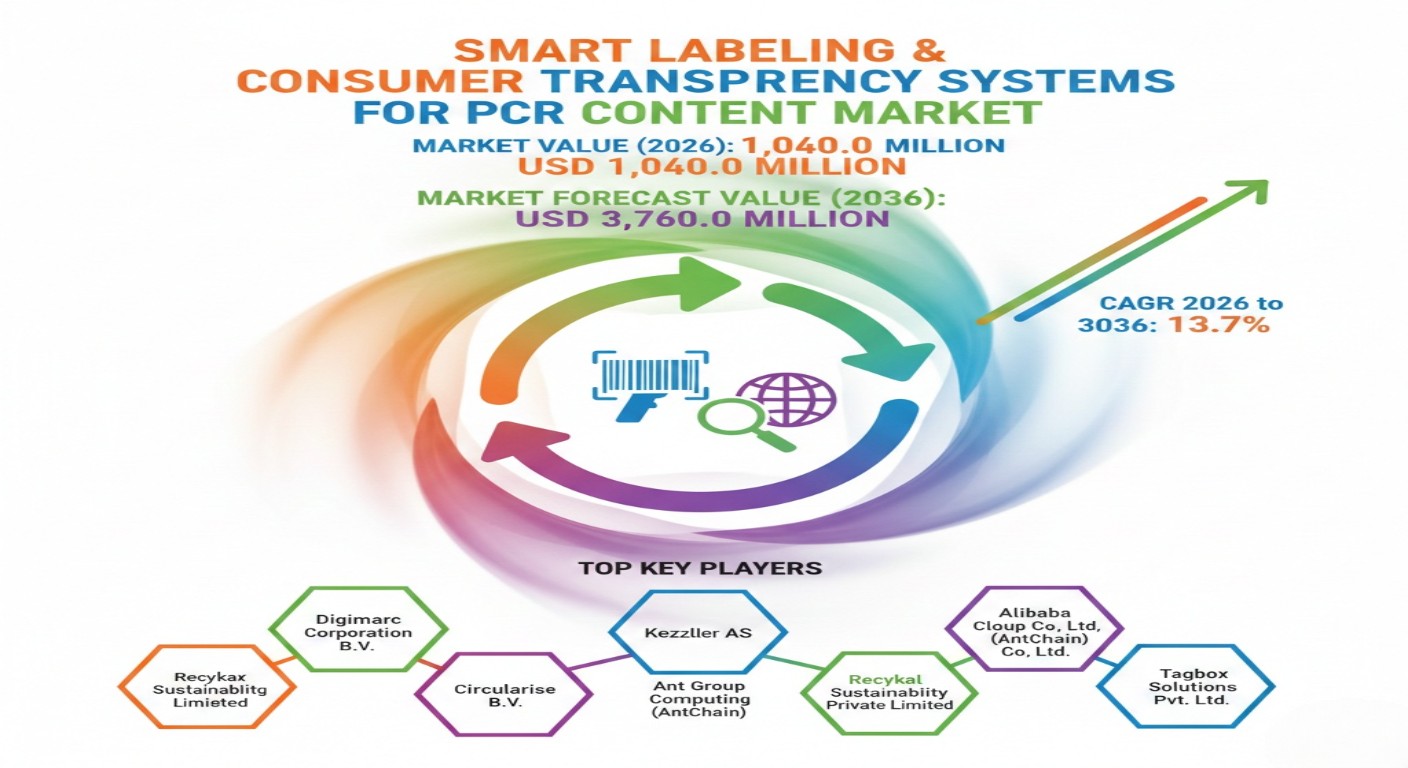
Smart Labeling & Consumer Transparency Systems for PCR Content Market
USA demand for smart labeling and PCR transparency system is growing at a 12.8% CAGR, helping brands verify recycled content, ESG compliance and consumer trust.
NEWARK, DE, UNITED STATES, February 3, 2026 /EINPresswire.com/ -- The global smart labeling and consumer transparency systems for PCR content market is entering a decade of accelerated growth as brands, regulators, and consumers demand verifiable proof behind recycled-content claims. According to the latest market assessment, the sector is valued at USD 1,040.0 million in 2026 and is projected to reach USD 3,760.0 million by 2036, expanding at a compound annual growth rate (CAGR) of 13.7% between 2026 and 2036.
The market’s evolution is being shaped less by who prints the label and more by who controls the data verification layer behind PCR claims. Platform providers capable of translating audit-ready PCR data into consumer-facing disclosures—without exposing supplier-sensitive information—are emerging as the primary beneficiaries.
Request Your Sample Now – Unlock Growth Potential and Discover Key Market Opportunities!
https://www.futuremarketinsights.com/reports/sample/rep-gb-30966
Market Snapshot: Smart Labeling & Consumer Transparency Systems for PCR Content
• Market value (2026): USD 1,040.0 million
• Forecast value (2036): USD 3,760.0 million
• CAGR (2026–2036): 13.7%
• Leading interface type: QR codes & digital product passports (48% share)
• Largest end-use segment: Consumer packaging & electronics (42% share)
• Key growth regions: Asia Pacific, North America, Latin America
Why Smart Labeling for PCR Content Is Gaining Strategic Importance
The market is advancing rapidly as traditional on-pack sustainability claims prove insufficient under rising regulatory scrutiny. Static text labels often fail to convey the depth of information required to substantiate PCR usage, certification status, and sourcing integrity.
Smart labeling systems bridge this gap by linking physical packaging to digital data layers such as cloud-based traceability platforms, certification references, and permissioned databases through interfaces including QR codes, digital product passports, NFC tags, and digital watermarks. These systems enable real-time, auditable disclosure of PCR content, supporting both compliance and consumer trust.
Key growth drivers include:
• Increased enforcement against misleading environmental claims
• Expansion of recycled-content mandates and Extended Producer Responsibility (EPR) frameworks
• Rising consumer demand for accessible, proof-backed sustainability information
• Brand efforts to mitigate greenwashing risk while maintaining operational flexibility
Segment Overview: Where Demand Is Concentrated
Consumer Packaging & Electronics Lead Adoption
Consumer packaging and electronics account for 42% of total market demand, reflecting high exposure to consumer scrutiny and regulatory oversight. These sectors operate at scale, across multiple geographies, and face elevated reputational risk from unsubstantiated PCR claims. Smart labeling enables standardized, region-specific disclosure of recycled content percentages, sourcing narratives, and compliance documentation.
QR Codes and Digital Product Passports Dominate Interfaces
QR codes and digital product passports represent 48% of interface adoption, driven by:
• Compatibility with smartphones and existing packaging formats
• Low deployment cost compared to hardware-intensive alternatives
• Ability to support future regulatory requirements through structured, updateable data
As transparency initiatives scale across portfolios and regions, QR-enabled digital passports remain the preferred mechanism for PCR communication.
Regional Growth Outlook Highlights
The market is expanding globally, with growth rates reflecting regulatory maturity, digital adoption, and PCR usage intensity:
• India: 15.4% CAGR, driven by EPR enforcement and rising consumer awareness
• China: 14.6% CAGR, supported by export-oriented manufacturing and digital ecosystems
• United States: 12.8% CAGR, reflecting strong retailer and ESG disclosure pressure
• Germany: 12.4% CAGR, underpinned by regulatory rigor and transparency-focused consumers
• Brazil: 11.6% CAGR, influenced by multinational brand standards and retail modernization
Asia Pacific leads growth as PCR adoption accelerates alongside digital labeling infrastructure, while North America and Europe continue to prioritize compliance-grade transparency.
Competitive Landscape: Data Credibility as the Differentiator
Competition in the smart labeling and PCR transparency market is increasingly defined by platform scalability, data governance, and audit readiness, rather than standalone labeling tools.
Key players include:
• Digimarc Corporation, positioning digital watermarks and enterprise-grade product identity as foundational infrastructure
• Circularise B.V. and Kezzler AS, emphasizing permission-based data exchange, serialization, and compliance with EU digital product passport frameworks
• Ant Group Co., Ltd. (AntChain) and Alibaba Cloud Computing Co., Ltd., leveraging blockchain-enabled traceability for high-volume manufacturing and export flows
• Recykal Sustainability Private Limited and Tagbox Solutions Pvt. Ltd., linking recycling operations and PCR verification directly to consumer-facing engagement tools
Across the market, pricing power is being defended through proprietary identifier frameworks, integration with packaging-line workflows, and governance models that make data access permissioned and audit-ready.
Market Outlook: From Marketing Tool to Compliance Infrastructure
As recycled-content mandates expand and greenwashing concerns intensify, smart labeling systems are shifting from optional engagement tools to core compliance and data communication infrastructure. Brands are increasingly mandating supplier-level PCR data integration, while retailers encourage transparent disclosures to support responsible sourcing narratives.
Why FMI: https://www.futuremarketinsights.com/why-fmi
Have a Look at Related Research Reports on the Packaging Domain:
Deblistering Machines Market https://www.futuremarketinsights.com/reports/deblistering-machines-market
Polyethylene Furanoate (PEF) Barrier Resin Market https://www.futuremarketinsights.com/reports/polyethylene-furanoate-pef-barrier-resin-market
Growlers Market https://www.futuremarketinsights.com/reports/growlers-market
Paint Cans Market https://www.futuremarketinsights.com/reports/paint-cans-market
About Future Market Insights (FMI)
Future Market Insights, Inc. (FMI) is an ESOMAR-certified, ISO 9001:2015 market research and consulting organization, trusted by Fortune 500 clients and global enterprises. With operations in the U.S., UK, India, and Dubai, FMI provides data-backed insights and strategic intelligence across 30+ industries and 1200 markets worldwide.
Sudip Saha
Future Market Insights Inc.
+1 347-918-3531
email us here
Legal Disclaimer:
EIN Presswire provides this news content "as is" without warranty of any kind. We do not accept any responsibility or liability for the accuracy, content, images, videos, licenses, completeness, legality, or reliability of the information contained in this article. If you have any complaints or copyright issues related to this article, kindly contact the author above.
