

Global B2B Ingredient Market Forecast to Reach USD 655.8 Billion in 2026, Expand to USD 913.6 Billion by 2036
Market analysis reveals a structural shift to performance-led B2B ingredients, with strong regional growth and relevance across manufacturing supply chains.
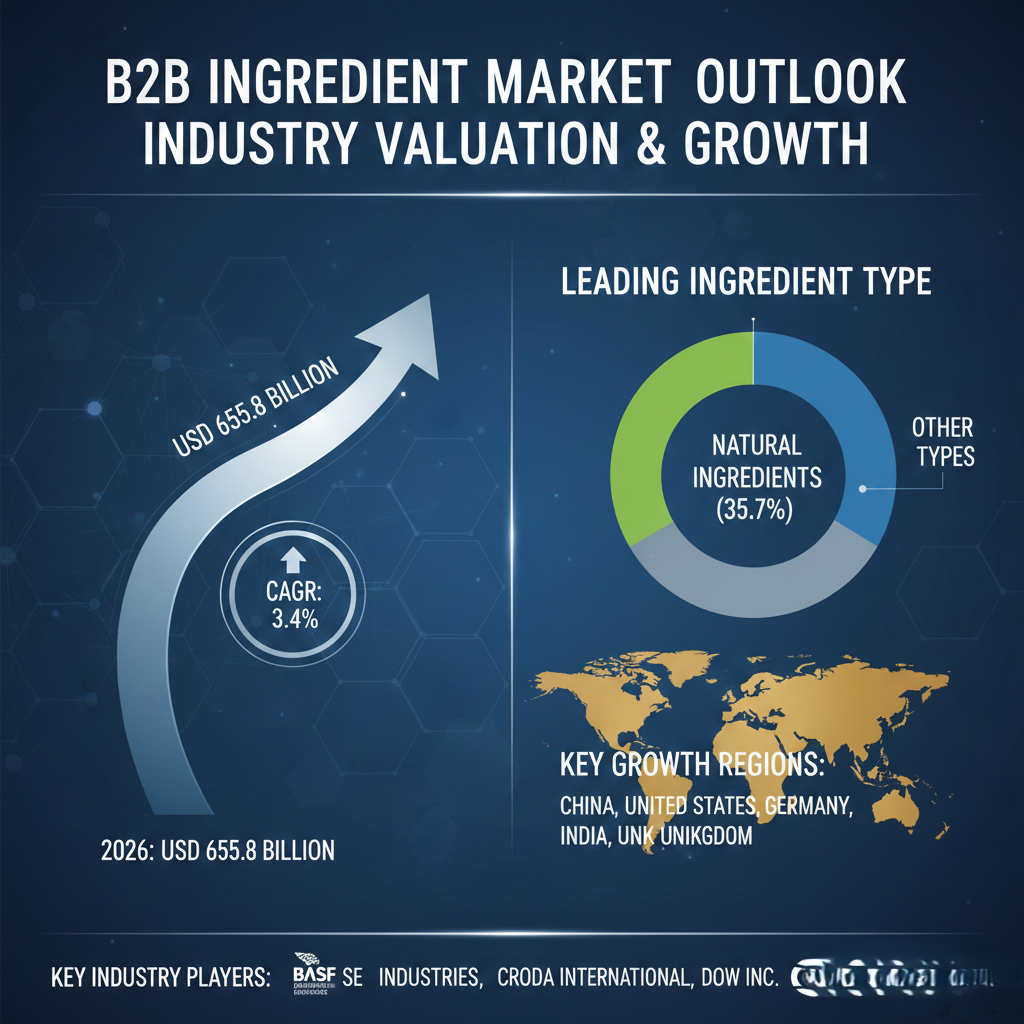
NEWARK, DE, UNITED STATES, February 3, 2026 /EINPresswire.com/ -- The global business-to-business (B2B) ingredient market is projected to expand substantially over the next decade, increasing from an estimated USD 655.8 billion in 2026 to USD 913.6 billion by 2036, according to Future Market Insights’ latest industry analysis. This forecast reflects a 3.4% compound annual growth rate (CAGR) from 2026 to 2036 and underscores a structural industry transformation driven by performance optimization, regulatory compliance, and manufacturing efficiency.
Shift from Commodity Inputs to Performance-Driven Systems
Manufacturers across sectors are increasingly adopting specialized, performance-oriented ingredients over traditional commodity chemicals. These advanced ingredient systems improve formulation efficiency, product stability, and end-product differentiation, and are seen as core contributors to operational performance, not just raw materials.
Industry leaders are prioritizing multifunctional actives, bio-based alternatives, and engineered delivery platforms, which replace multiple legacy components while delivering consistent functional outcomes under real-world processing, storage, and distribution conditions.
“Logistics management and supply chain management are just different ways of saying capital allocation,” commented a senior industry executive, highlighting the strategic shift toward value optimization over price minimization.
Natural Ingredients Lead Market Adoption
Within the broader B2B ingredient landscape, natural ingredients hold the largest market share, accounting for approximately 35.7% of demand. This leadership reflects rising regulatory pressure for bio-based inputs, clean-label expectations, and brand risk considerations in consumer-facing sectors like personal care and pharmaceuticals.
The personal care segment alone accounts for the highest end-use demand, representing 42.1% of the total B2B ingredient market. Manufacturers in this category increasingly select ingredients that support safety claims, sensory differentiation, and premium brand positioning.
Functional Additives Drive Formulation Innovation
Among functional categories, emulsifiers stand out as the most demanded ingredient class. Their ability to stabilize multiphase systems enhances product consistency, shelf life, and process robustness while reducing formulation complexity and cost per function. Industry players such as BASF SE, Evonik Industries, and Croda International are advancing these multifunctional systems globally.
Market Growth Across Key Regions
Regional forecasts indicate distinct growth dynamics across major manufacturing hubs:
• China is expected to grow at a 4.2% CAGR, driven by vertically integrated manufacturing ecosystems where ingredient optimization is central to productivity.
• India is projected to achieve a 4.6% CAGR, the fastest among key markets, supported by industrial expansion, cost discipline, and government support for chemical manufacturing.
• United States growth (approximately 3.8% CAGR) reflects strong innovation culture and early integration of advanced ingredients in product design.
• Germany and the United Kingdom are forecast at 3.5% and 3.2% CAGR respectively, underlining engineering-led ingredient selection focused on documentation, precision, and regulatory compliance.
Regulatory and Operational Drivers
Market momentum is influenced by evolving regulatory frameworks that elevate sustainability, safety, and traceability from voluntary goals to enforceable standards. Such regulatory pressure favors bio-based, multifunctional, and well-documented ingredient systems that support compliance and manufacturing resilience.
Digital procurement platforms and Industry 4.0 manufacturing systems further accelerate adoption by integrating technical data, traceability, and compliance documentation directly into workflows, reducing adoption friction and operational variability.
Industry Relevance and Market Outlook
Manufacturers seeking efficiency, product consistency, and competitive differentiation are increasingly valuing B2B ingredient suppliers as strategic partners rather than commodity vendors. The integration of comprehensive technical services, documentation support, and tailored ingredient systems is becoming a standard expectation across sectors.
This growth outlook offers industry leaders, investors, and analysts a detailed perspective on global trends shaping the B2B ingredient market, including structural evolution, regional dynamics, and functional innovation.
Request for Sample Report | Customize Report |purchase Full Report – https://www.futuremarketinsights.com/reports/sample/rep-gb-31776
Explore More Related Studies Published by FMI Research:
Mining Flotation Chemicals Market https://www.futuremarketinsights.com/reports/global-mining-flotation-chemicals-market
Textile Flooring Market https://www.futuremarketinsights.com/reports/textile-floorings-market
Chlorinated Polyethylene Resins and Elastomers (CPE) Market https://www.futuremarketinsights.com/reports/chlorinated-polyethylene-resins-elastomers-market
About Future Market Insights (FMI)
Future Market Insights, Inc. (FMI) is an ESOMAR-certified, ISO 9001:2015 market research and consulting organization, trusted by Fortune 500 clients and global enterprises. With operations in the U.S., UK, India, and Dubai, FMI provides data-backed insights and strategic intelligence across 30+ industries and 1200 markets worldwide.
Why Choose FMI: https://www.futuremarketinsights.com/why-fmi
Sudip Saha
Future Market Insights Inc.
+1 347-918-3531
rahul.singh@futuremarketinsights.com
Legal Disclaimer:
EIN Presswire provides this news content "as is" without warranty of any kind. We do not accept any responsibility or liability for the accuracy, content, images, videos, licenses, completeness, legality, or reliability of the information contained in this article. If you have any complaints or copyright issues related to this article, kindly contact the author above.
