

Beinsure forecasts Global Insurance Market Growth in 2026-2027 slowing amid rising risks

Beinsure outlines how weaker GDP growth, trade tension, and higher catastrophe losses are reshaping insurance premium growth and risk dynamics
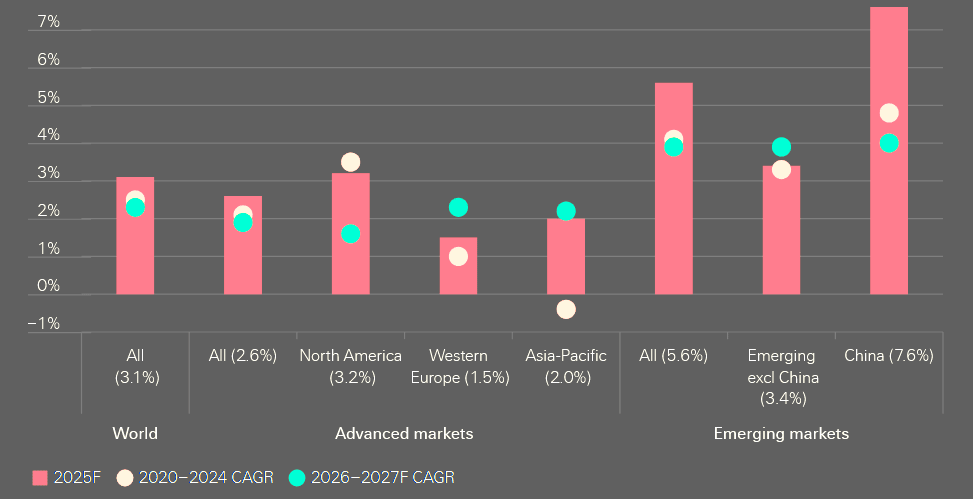
Global total insurance premium real growth rates by regions / Source: Beinsure.com by Swiss Re's data
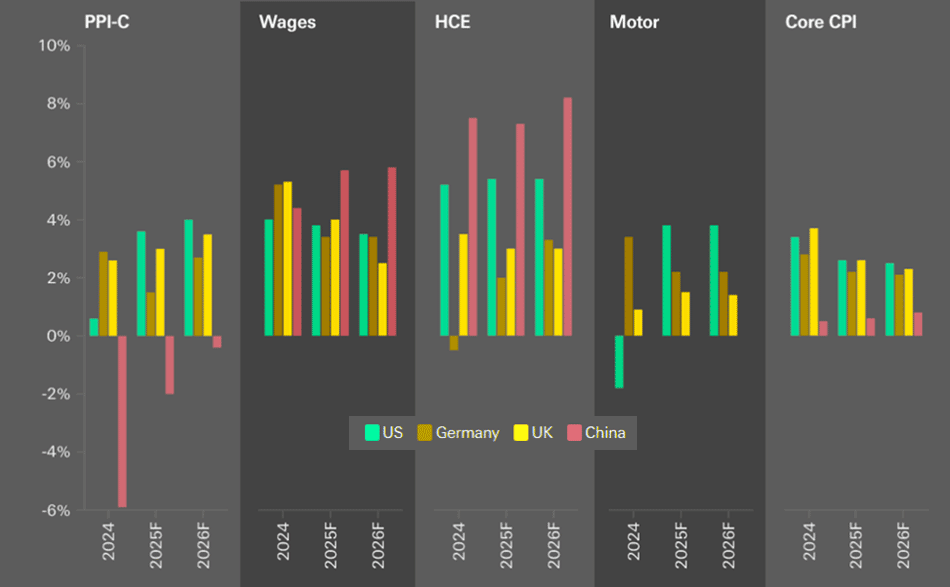
CPI inflation by market and sub-category, year-on-year / Source: Beinsure.com by Swiss Re's data
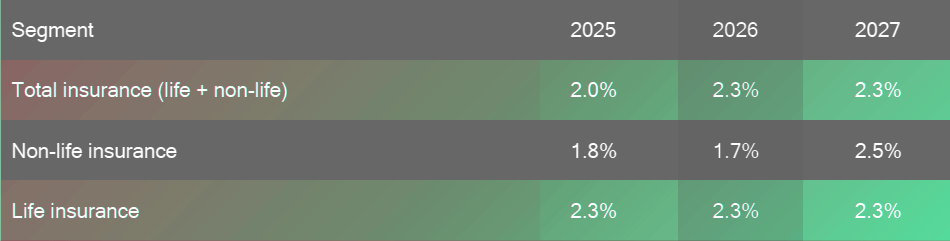
Global insurance premium growth outlook / Source: Beinsure.com by Swiss Re’s data
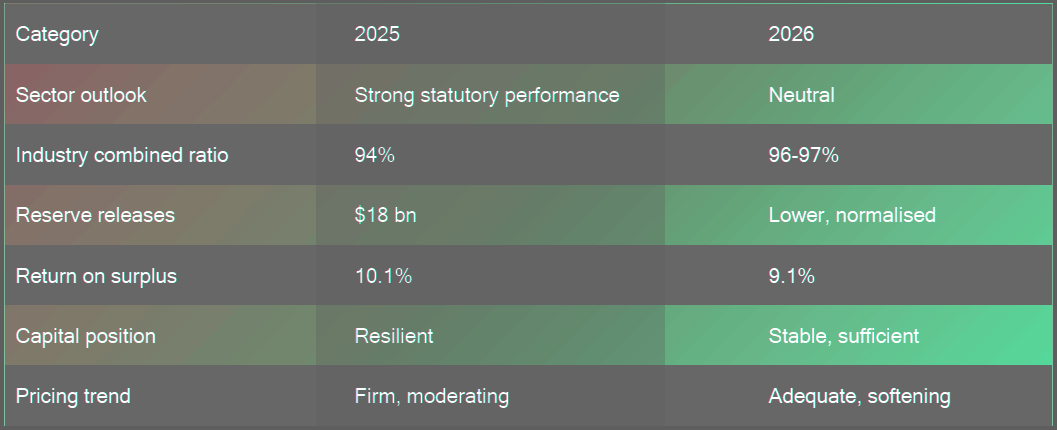
P&C insurance sector outlook and performance snapshot / Source: Beinsure.com
Beinsure Media outlines how weaker GDP growth, trade tension, and higher catastrophe losses are reshaping global insurance premium growth and risk dynamics
According to Beinsure's Global GDP and Insurance Premiums Outlook, the combination of slower growth, persistent uncertainty, demographic shifts, and rising catastrophe risk defines the next phase for the insurance industry. Growth continues, but it is harder won. Volatility rises. Capital strength, insurance pricing discipline, and risk selection matter more.
Analysts forecast global real GDP growth of 2.5% in 2026 and 2.6% in 2027, following an expected slowdown to 2.3% in 2025. That compares with an estimated 2.8% expansion in 2024. The moderation reflects cooling labour markets, weaker trade flows, and a policy backdrop dominated by tariffs and geopolitical strain rather than coordinated growth support.
The data reviewed by Beinsure outlines the Global GDP growth trajectory clearly:
— 2025: 2.3%, as tariff uncertainty, weaker trade, and softer demand take hold
— 2026: 2.5%, helped by looser fiscal stances and slower labor markets
— 2027: 2.6%, as growth stabilizes and US performance converges with peers
"This is not a collapse scenario. It is a grind-down, with less margin for error and fewer tailwinds", Beinsure analysts believe.
Beinsure notes that policymakers have shown limited appetite to acknowledge this dilemma directly, increasing the likelihood of shorter, sharper economic cycles and more volatile markets.
Against this backdrop, global insurance premium growth is set to slow. Insurers expect combined life and non-life premium growth to average 2.3% in real terms in 2026-2027, slightly below the 2.5% compound annual growth rate recorded over the past five years.
"We expect global insurance premiums in non-life sector to grow by 1.7% in real terms in 2026, before improving to around 2.5% in 2027. Trade-exposed lines are most sensitive to the economic slowdown," predicts Oleg Parashchak, CEO of Finance Media and Editor-in-Chief of Beinsure. "Marine, trade credit, and construction insurance see the impact earlier as trade volumes weaken and investment slows".
Beinsure analysts note that after a strong 2024, momentum is clearly cooling. Total premiums are expected to grow by about 2% in real terms in 2025, down sharply from an estimated 5.2% in 2024, before edging back to 2.3% in 2026.
"Beyond 2027, we see growth stabilizing around 2.3%, supported by structural drivers such as rising natural catastrophe exposure and escalating liability costs in non-life lines," noted Tetiana Mykhailova, CFO of Beinsure. These forces support premium volumes, but they also increase volatility and capital demands.
The global P&C insurance market has doubled in size over the past 20 years, reaching about $2.4 tn. Growth did not come from volume alone. Innovation steadily widened access to coverage, mixing conventional insurance with alternative risk structures that barely existed two decades ago.
Global P&C insurance pricing decline as market shifts toward softer cycles. Global insurance market drifting into a progressively softer setting, with pricing momentum slipping across most European and US P&C insurance lines (see 2026 U.S. Property and Casualty Insurance Outlook - https://beinsure.com/outlook-us-pc-insurance-sector-fitch/ ).
Capacity looks different now. Risk transfer spreads across traditional carriers, reinsurance, and capital markets in ways that would have sounded ambitious years ago. According to Beinsure analysts, this expansion reshaped who can buy cover and how risks move through the system.
Tariffs play a direct role. In the US, higher tariffs raise repair and replacement costs, pushing up claims severity in motor and construction, according to Insurance News US report. Outside the US, tariffs may exert a more disinflationary effect, easing some claims pressure but also weighing on premium growth.
"Trade wars leave no winners in the short term, but over time they reallocate production and trade flows globally. That transition period raises risks for firms and consumers, including more volatile exchange rates, asset prices, and investment returns. New developments in the Middle East conflict add further strain, amplifying uncertainty already embedded in markets," says Oleg Parashchak.
The US is still expected to outperform other advanced economies, but the gap is narrowing. Labour market momentum is easing, financial conditions remain tight, and uncertainty around trade and fiscal policy continues to weigh on investment decisions. Elsewhere, growth remains constrained by softer demand, fragmented trade relationships, and uneven policy responses.
The slowdown comes at a time when the global economy is undergoing large macroeconomic regime shifts. The period often described as the Great Moderation – marked by steady growth, low inflation volatility, and predictable cycles – is over. According to BlackRock’s Investment Outlook ( https://beinsure.com/blackrock-global-invest-macroeconomic-outlook/ ), the global economy has moved into a phase of heightened macro volatility, where both bonds and equities command higher risk premia.
Central banks, focused on inflation rooted in supply constraints rather than demand excess, face uncomfortable trade-offs. Aggressive tightening risks choking growth, while looser policy risks entrenching inflation.
Earnings momentum in non-life insurance is cooling, but investment income provides an important offset. With long-dated yields structurally higher than in the past decade, insurers derive more support from their asset portfolios. According to Beinsure, that income stream matters far more today than it did five years ago, helping to cushion underwriting volatility.
Life insurance presents a steadier picture. Beinsure expects global life premium growth to average about 2.3% over the next two years, supported by demand that remains above pre-pandemic levels and by higher interest rates in key markets such as the US.
"For 2025 and 2026, global life premiums are projected to grow at around 3% annually, more than double the average rate of the past decade," Oleg Parashchak stated. The report attributes this to rising real wages, sustained higher interest rates, ageing populations, and the expanding middle class in emerging economies.
Still, life insurers are not immune to macro stress. Pressure comes indirectly through labour markets, asset values, and household balance sheets.
Beinsure notes that insurers will need to shift focus from the accumulation phase of consumers’ lives toward the decumulation phase.
The move from defined benefit to defined contribution pension models accelerates this shift. As guaranteed-income retirement plans phase out, risks previously held on corporate balance sheets migrate toward insurers. Demand for longevity products and long-term care solutions is also set to rise as people live longer and require more complex retirement and care planning.
Beyond premiums, the broader macro setting keeps shifting. Industrial policy now plays a larger role in shaping economies, altering capital allocation and risk pricing. Fiscal and monetary policy appear looser in aggregate, a mix that may buffer growth against tariffs but also leaves the door open to renewed inflation pressure.
US tariff policy continues to weigh on global growth and insurance outcomes. Consumers and firms have likely already cut spending and investment in response to uncertainty, even if the full effects have yet to show up in headline data.
Tariffs affect insurers through premium growth, claims costs, and investment returns, with effects varying by region. Beinsure sees the most direct impact on US non-life claims severity, especially in motor and construction. Outside the US, tariffs tend to reduce inflationary pressure, easing claims costs but also dampening growth. Learn how US tariffs affect the global insurance industry - https://beinsure.com/impact-tariffs-global-insurance/
Long-tail lines are particularly exposed. Inflation, litigation trends, and slower repricing strain reserves, leaving less room for error in underwriting and capital management.
Perhaps the starkest signal comes from insured losses. Analysts warn that global insured losses could exceed $300 bn in a peak year, driven mainly by primary perils such as hurricanes and earthquakes. With the reinsurance sector holding around $500 bn in capital, the system can absorb such shocks – but not without consequences for pricing, capacity, and volatility.
These high losses resulted primarily from California wildfires, which contributed approximately $37.5 bn, or 71% of the total insured losses.
Beinsure emphasizes that peak loss years should no longer be treated as rare outliers. Secondary perils already generate around $50 bn in losses annually. A severe hurricane or major earthquake hitting a densely populated, highly insured region could push total insured losses beyond $300 bn in a single year.
Beinsure.com is a B2B digital insurance media platform focused on insurance, reinsurance, InsurTech, cyber, SaaS and blockchain technologies. "We offer comprehensive coverage, in-depth analyses, and trusted reviews on a wide range of topics related to insurance. We are great resource for re/insurers and investors looking to stay informed on insurance and financial market," Oleg Parashchak says. It aims to simplify these industries by providing the latest news, ratings, reviews, and market insights.
Nataly Kramer
Beinsure.com
email us here
Legal Disclaimer:
EIN Presswire provides this news content "as is" without warranty of any kind. We do not accept any responsibility or liability for the accuracy, content, images, videos, licenses, completeness, legality, or reliability of the information contained in this article. If you have any complaints or copyright issues related to this article, kindly contact the author above.
