

A sugar signal that ages leaves: How sorbitol speeds up senescence in apple
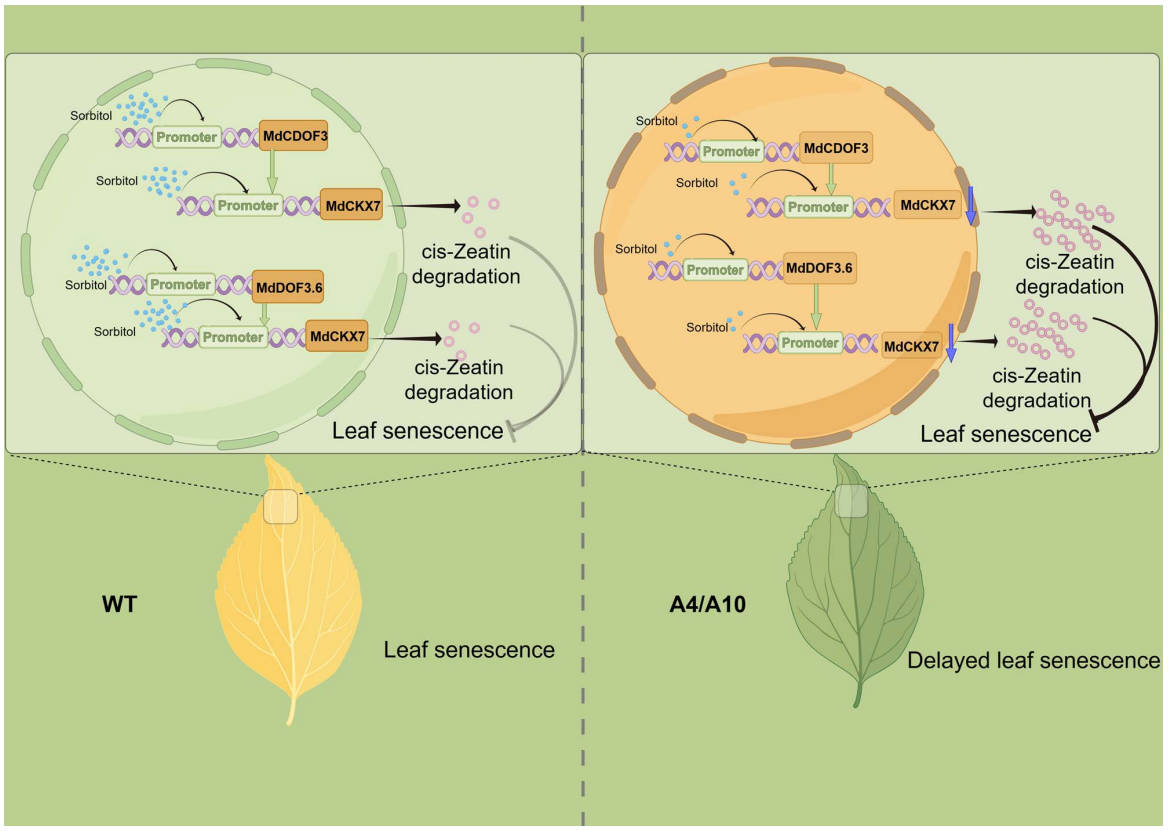
A pattern diagram of MdCDOF3/MdDOF3.6-MdCKX7 mediated leaf senescence.
GA, UNITED STATES, January 9, 2026 /EINPresswire.com/ -- Leaf senescence is a tightly regulated developmental process that directly affects plant productivity and lifespan. Understanding how metabolic signals interact with hormonal pathways to control senescence remains a central challenge in plant biology. This study reveals a molecular mechanism by which sorbitol, a major photosynthetic product in many fruit trees, acts as a signaling molecule to accelerate leaf senescence. By activating two DNA-binding transcription factors that promote cytokinin degradation, sorbitol shifts hormonal homeostasis toward aging. The findings uncover how carbon status is translated into transcriptional and hormonal responses, providing new insight into the integration of metabolism and developmental regulation during leaf aging.
Leaf senescence determines the duration of photosynthesis, nutrient remobilization efficiency, and ultimately crop yield and quality. Cytokinins are well known for delaying senescence by maintaining chlorophyll content and antioxidant capacity, while reduced cytokinin levels are closely associated with accelerated leaf aging. At the same time, sugars are increasingly recognized as signaling molecules rather than passive energy sources. In apple and other Rosaceae species, sorbitol represents the dominant form of carbon transport and storage. However, how sorbitol signaling intersects with hormone metabolism to regulate leaf senescence remains poorly understood. Based on these challenges, it is necessary to conduct in-depth research on how sorbitol signaling modulates cytokinin homeostasis during leaf senescence.
Researchers from Shandong Agricultural University report new insights into the molecular regulation of leaf senescence in a study published (DOI: 10.1093/hr/uhaf120) on April 29, 2025, in Horticulture Research. The study demonstrates that sorbitol signaling activates two DOF transcription factors, MdCDOF3 and MdDOF3.6, which promote cytokinin degradation through transcriptional activation of MdCKX7. Using genetic, physiological, and molecular approaches, the research uncovers a regulatory module that links carbon metabolism to hormonal control of leaf aging in apple.
The researchers first examined apple plants with reduced sorbitol synthesis caused by antisense repression of A6PR, a key enzyme in sorbitol biosynthesis. These plants exhibited delayed leaf senescence, higher chlorophyll retention, enhanced antioxidant activity, and elevated levels of the cytokinin cis-zeatin. Transcriptome analyses revealed that this phenotype was associated with strong downregulation of MdCKX7, a gene encoding a cytokinin oxidase responsible for cytokinin degradation.
Functional assays confirmed that overexpression of MdCKX7 accelerated leaf senescence, whereas transient silencing of MdCKX7 delayed aging, establishing its central role in regulating cytokinin levels. Further analyses identified two DNA-binding One Zinc Finger transcription factor genes, MdCDOF3 and MdDOF3.6, that were co-expressed with MdCKX7 and strongly induced by sorbitol. Molecular binding assays demonstrated that the MdCDOF3 and MdDOF3.6 transcription factors directly bind to specific regions of the MdCKX7 promoter and activate its transcription.
Importantly, exogenous sorbitol treatments rapidly increased the expression of MdCDOF3, MdDOF3.6, and MdCKX7, whereas reduced sorbitol levels suppressed this regulatory cascade. Together, these findings define a sorbitol-responsive transcriptional module that promotes cytokinin degradation and drives leaf senescence.
“This work shows how plants convert carbon status into developmental signals,” said a senior author of the study. “Sorbitol is not merely a transport sugar—it functions as a signaling molecule that activates specific transcription factors to regulate cytokinin metabolism. By identifying the MdCDOF3/MdDOF3.6–MdCKX7 regulatory module, we provide mechanistic insight into how metabolic cues directly influence the timing of leaf senescence, which is critical for understanding plant aging and productivity.”
The identification of a sorbitol-driven regulatory module controlling leaf senescence has important implications for perennial fruit crops. Targeted manipulation of genes such as MdCKX7, MdCDOF3, or MdDOF3.6 could provide new strategies to delay premature leaf aging, extend the photosynthetic period, and improve yield stability under environmental stress. Beyond apple, this mechanism may operate in other sorbitol-transporting species, offering broader relevance for horticultural improvement. More generally, the study provides a conceptual framework for understanding how carbon signaling integrates with transcriptional regulation and hormone homeostasis to control plant lifespan.
DOI
10.1093/hr/uhaf120
Original Source URL
https://doi.org/10.1093/hr/uhaf120
Funding information
This work was supported by grants from the National Key Research and Development Program of China (2023YFD2301000, 2022YFD2100100), the National Natural Science Foundation of China (32122080), the Key Research and Development Program of Shandong Province (2023CXGC010709), the Taishan Scholar Project Special Funds of China (Grant No.tsqnz20231206), and the Natural Science Foundation of Shandong Province (ZR2024QC255).
Lucy Wang
BioDesign Research
email us here
Legal Disclaimer:
EIN Presswire provides this news content "as is" without warranty of any kind. We do not accept any responsibility or liability for the accuracy, content, images, videos, licenses, completeness, legality, or reliability of the information contained in this article. If you have any complaints or copyright issues related to this article, kindly contact the author above.
