
Hybrid metal–organic framework catalysts redefine sustainable nitrogen chemistry
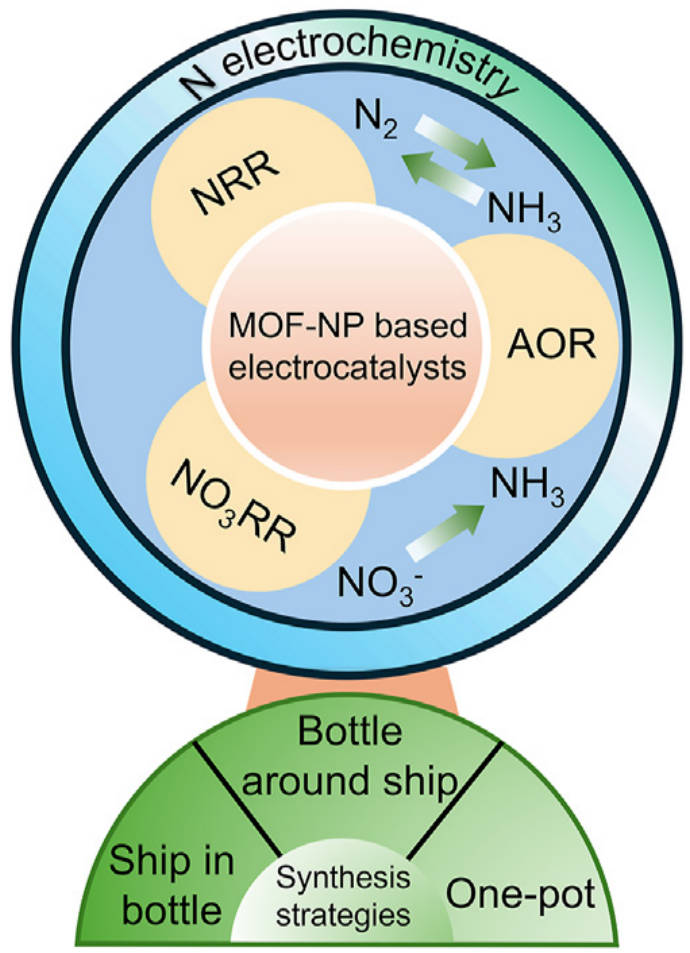
Schematic of MOF–Nanoparticle Hybrid Electrocatalysts for Nitrogen Conversio.
GA, UNITED STATES, December 22, 2025 /EINPresswire.com/ -- Sustainable nitrogen transformation is central to clean energy development, environmental protection, and future chemical manufacturing. This study summarizes major advancements in designing metal–organic framework–nanoparticle (MOF–NP) composite catalysts that accelerate key nitrogen electrochemical reactions under mild conditions. By integrating the structural tunability and porosity of metal–organic frameworks MOFs with the conductivity and catalytic activity of nanoparticles, these hybrid materials significantly improve nitrogen reduction, nitrate reduction, and ammonia oxidation. The analysis highlights how MOF–NP interfaces enhance reaction selectivity, stabilize intermediates, increase Faradaic efficiency, and support strong long-term durability. Together, these performance gains position MOF–NP composites as promising candidates for green ammonia synthesis, nitrate remediation, and next-generation nitrogen-based energy systems.
For decades, industrial nitrogen conversion has relied on the energy-intensive Haber–Bosch process, which requires high temperatures and pressures, consumes fossil fuels, and contributes notably to global CO₂ emissions. At the same time, nitrate accumulation in water—driven by fertilizers and industrial waste—has become a pressing environmental challenge. Ammonia is also gaining attention as a carbon-free hydrogen carrier, further increasing the demand for efficient nitrogen electrochemical technologies. Yet current systems suffer from low catalytic activity, poor conductivity, and strong competition from side reactions such as hydrogen evolution. Because of these challenges, deeper investigation into metal–organic framework–nanoparticle (MOF–NP) composite materials for nitrogen electrochemistry is needed.
A team from Sungkyunkwan University, Yangzhou University, Tsinghua University, and collaborating institutes reported on November, 2025, a comprehensive analysis published (DOI: 10.1016/j.esci.2025.100378) in eScience examining how rationally engineered MOF–NP composites enable high-performance nitrogen electrochemical reactions. Their study evaluates synthesis strategies, structural tuning, catalytic mechanisms, and performance benefits of these hybrid materials across nitrogen reduction, nitrate reduction, and ammonia oxidation. The findings reveal how MOF architectures, nanoparticle dispersion, and interface engineering work together to create highly active, selective, and durable catalysts.
The researchers identify three major synthesis routes—growing MOFs on nanoparticles, loading nanoparticles into MOFs, and one-pot simultaneous formation—each offering distinct control over electron pathways, pore accessibility, and catalytic interfaces. These strategies overcome intrinsic limitations of pristine MOFs, such as low conductivity and insufficient active sites.
For nitrogen reduction, embedding Au, PdCu, Ru, or MoS₂ nanoparticles within MOFs enhances N₂ adsorption, stabilizes N₂Hx intermediates, and suppresses hydrogen evolution. Examples include AuCu/ZIF-8, PdCu@UiO-S@PDMS, and Ru single-atom catalysts derived from ZIF-8 or UiO-66, all of which deliver high ammonia yields and improved Faradaic efficiencies.
For nitrate reduction, MOF–NP systems such as Pd-nanodots/Zr-MOF, Cu@CuHHTP, and UiO-CuZn demonstrate exceptional selectivity and conversion rates. Their porous architectures and engineered interfaces stabilize *HNO intermediates and facilitate rapid electron–proton transfer.
In ammonia oxidation, Pt–Ir–Zn nanoparticles supported on CeO₂/ZIF-8 carbon frameworks exhibit accelerated reaction kinetics by lowering N–H bond cleavage barriers, outperforming conventional Pt-based catalysts.
Overall, the study shows that defect engineering, metal–ligand coordination tuning, nanoparticle confinement, and electronic structure modulation within MOF–NP hybrids dramatically enhance activity, selectivity, and durability across all three nitrogen electrochemical pathways.
According to the authors, MOF–NP composites provide a powerful materials platform for reshaping the nitrogen cycle using renewable electricity. They emphasize that the synergy between porous MOF networks and highly active nanoparticles enables precise control of adsorption energies, intermediate stabilization, and charge-transfer behavior. These capabilities, they note, are essential for achieving efficient ammonia synthesis, scalable nitrate remediation, and high-performance ammonia oxidation for clean energy systems. The researchers further highlight that progress in in-situ characterization, theoretical modeling, and AI-assisted catalyst discovery will be critical for accelerating future advancements.
The development of MOF–NP electrocatalysts opens new pathways for clean nitrogen management across environmental and industrial sectors. Their ability to convert N₂ into ammonia under ambient conditions could reduce reliance on the carbon-intensive Haber–Bosch process, enabling decentralized, renewable-powered fertilizer production. High-efficiency nitrate-to-ammonia conversion offers dual benefits for wastewater treatment and resource recovery. Meanwhile, advanced ammonia oxidation catalysts support the emerging ammonia-fuel economy, enabling safe, carbon-neutral energy storage and conversion. With continued innovation in scalable synthesis and interface engineering, MOF–NP composites may become foundational materials for future sustainable nitrogen technologies.
DOI
10.1016/j.esci.2025.100378
Original Source URL
https://doi.org/10.1016/j.esci.2025.100378
Funding information
This work was supported by the National Research Foundation of Korea (NRF) grant funded by the Korean government (MSIT) (No. NRF-2020R1A3B2079803 and No. RS-2024-00453815), Republic of Korea.
Lucy Wang
BioDesign Research
email us here
Legal Disclaimer:
EIN Presswire provides this news content "as is" without warranty of any kind. We do not accept any responsibility or liability for the accuracy, content, images, videos, licenses, completeness, legality, or reliability of the information contained in this article. If you have any complaints or copyright issues related to this article, kindly contact the author above.
