

[2025] Petrochemicals Market Growth, Landscape, Trends and Opportunities, 2034
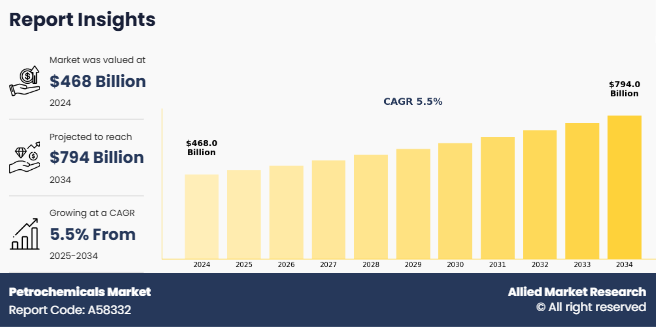
Petrochemicals Market CAGR
The global petrochemicals market is projected to reach $794.0 billion by 2034, growing at a CAGR of 5.5% from 2025 to 2034.
WILMINGTON, DE, UNITED STATES, December 3, 2025 /EINPresswire.com/ -- Allied Market Research published a report, titled, 'Petrochemicals Market by Type (Olefins, Aromatics, and Synthesis Gas), Product Type (Ethylene, Propylene, Benzene, Butadiene, Xylene, and Others), and Application (Aerospace, Agriculture, Automotive, Building & Construction, Consumer Goods, Packaging, and Others): Global Opportunity Analysis and Industry Forecast, 2025-2034'. According to the report, the petrochemicals market was valued at $468 billion in 2024, and is estimated to reach $794 billion by 2034, growing at a CAGR of 5.5% from 2025 to 2034.Download Sample Pages of Research Overview: https://www.alliedmarketresearch.com/request-sample/A58332
Challenges and Management Strategies
The petrochemicals market faces several challenges, including environmental concerns, price volatility of crude oil-based feedstocks, and increasing regulatory pressure to reduce carbon emissions. The heavy reliance on fossil fuels and energy-intensive production processes contributes to greenhouse gas emissions, raising sustainability issues and prompting demand for greener alternatives. In addition, fluctuating raw material prices impact profit margins and market stability. To address these challenges, companies are investing in advanced process technologies, such as carbon capture and utilization (CCU), feedstock diversification, and energy-efficient systems to minimize environmental impact and reduce costs. Innovations in bio-based and recycled petrochemical products are gaining traction, supporting the shift toward circular economy models. Moreover, strategic collaborations, digitalization, and supply chain optimization are implemented to improve operational resilience and ensure raw material security. The petrochemicals market mitigates its challenges and continues to play a vital role in modern industrial development by adopting these solutions.
Want to Access the Statistical Data and Graphs, Key Players' Strategies: https://www.alliedmarketresearch.com/petrochemicals-market/purchase-options
Governing Policies and Regulatory Impacts
Energy Efficiency Regulations European Union: The Ecodesign Directive (2009/125/EC) sets requirements for the energy efficiency of industrial equipment, including petrochemical processing units. The Energy Efficiency Directive (2012/27/EU) establishes measures to improve energy use in industrial sectors. U.S.: The U.S. Department of Energy (DOE) establishes efficiency standards for industrial energy use in petrochemical plants. The Energy Policy and Conservation Act (EPCA) mandates energy efficiency requirements for industrial processes.
Environmental Regulations Emissions Control: Regulations such as the U.S. Environmental Protection Agency (EPA) Clean Air Act and the European Union's Industrial Emissions Directive (2010/75/EU) impose limits on air pollutants from petrochemical facilities, including volatile organic compounds (VOCs) and sulfur oxides (SOx). Hazardous Substances Management: The Registration, Evaluation, Authorisation, and Restriction of Chemicals (REACH) Regulation (EC 1907/2006) in the EU and the Toxic Substances Control Act (TSCA) in the U.S. regulate the use of hazardous chemicals in the petrochemical industry.
Safety Standards ISO Standards: The International Organization for Standardization (ISO) provides safety standards such as ISO 45001 for occupational health and safety in petrochemical plants and ISO 10418 for offshore production safety. ASME Standards: The American Society of Mechanical Engineers (ASME) establishes standards for the design and construction of pressure vessels, pipelines, and processing equipment in petrochemical plants, such as ASME Boiler and Pressure Vessel Code (BPVC).
Building Codes and Standards International Building Code (IBC): In the U.S., the IBC and local building codes govern structural and fire safety requirements for petrochemical plants. API Standards: The American Petroleum Institute (API) provides standards such as API 650 for storage tanks and API 570 for pipeline inspection and maintenance.
Request For Customization: https://www.alliedmarketresearch.com/request-for-customization/A58332
Growth Opportunities & Future Outlook
Increase in use of petrochemicals in renewable energy applications is creating new opportunities for the petrochemical market , as these materials are increasingly being utilized in the development of energy-efficient technologies and renewable energy systems. Petrochemicals are crucial in the production of advanced materials used in solar panels, wind turbine blades, and energy storage systems, such as batteries and capacitors. In addition, the growth of bioplastics and bio-based resins, derived from petrochemicals, is enabling the renewable energy sector to achieve greater sustainability and reduce carbon footprints. As governments and industries ramp up their investments in renewable energy infrastructure, the demand for high-performance, durable, and cost-effective petrochemical products is expected to rise, positioning the petrochemical market as a key player in the transition to a more sustainable energy landscape. All these factors are anticipated to offer new growth opportunities for the petrochemicals market during the forecast period.
Access Full Summary Report: https://www.alliedmarketresearch.com/petrochemicals-market-A58332
Key Developments
In January 2024, SABIC Industrial Investment Company and Fujian Fuhua Gulei Petrochemical Co., Ltd. decided to build the Complex in Fujian's Gulei Industrial Park. With an estimated total investment of RMB 44.8 billion ($6.4 billion), it is another centerpiece of SABIC'sinvestment footprint in China and by far the largest foreign investment in Fujian.
Leading Market Players: -
BASF SE
ExxonMobil Corporation
SABIC
Dow Inc
Mitsubishi Chemical Holdings Corporation
Linde plc
Air Liquide S.A.
LyondellBasell Industries Holdings B.V.
Chevron Corporation
Shell Plc
The report provides a detailed analysis of these key players in the global petrochemicals market. These players have adopted different strategies such as new product launches, collaborations, expansion, joint ventures, agreements, and others to increase their market share and maintain dominant shares in different regions. The report is valuable in highlighting business performance, operating segments, product portfolio, and strategic moves of market players to showcase the competitive scenario.
For More Details: https://www.prnewswire.com/news-releases/petrochemicals-market-to-reach-794-billion-globally-by-2034-at-5-5-cagr-allied-market-research-302599604.html
David Correa
Allied Market Research
+ + + + + + + + + + + + +1 800-792-5285
email us here
Visit us on social media:
LinkedIn
Facebook
YouTube
X
Legal Disclaimer:
EIN Presswire provides this news content "as is" without warranty of any kind. We do not accept any responsibility or liability for the accuracy, content, images, videos, licenses, completeness, legality, or reliability of the information contained in this article. If you have any complaints or copyright issues related to this article, kindly contact the author above.
